
How Do I Teach My Child to Tell Time?
The short answer
Teach the clock one step at a time: the hour first, then the half hour, then counting the minutes by fives, and finally reading to the exact minute. The hour hand is what trips most children up, at every step: the hour is the number the short hand has just passed, not the one it is closest to. Most children read the hour and half hour in first grade and the exact minute by the end of third.

By Caitlin Damani, Founder, BrightPage · Reviewed · 6 min read
Start With the Hour Hand
A clock face asks a child to read two hands at once, with two different meanings, on one set of numbers. So take them one at a time. On the hour, the long hand always points straight up to the 12, and the child only has to read the short one. Once the short hand means “the hour” without a second thought, the long hand can start to mean minutes.
The Order to Teach It In
Each step adds one new idea to the last. Reading a clock and drawing the hands go together at each step: drawing makes a child decide which hand is which, so it shows quickly whether the idea has landed.
3:00
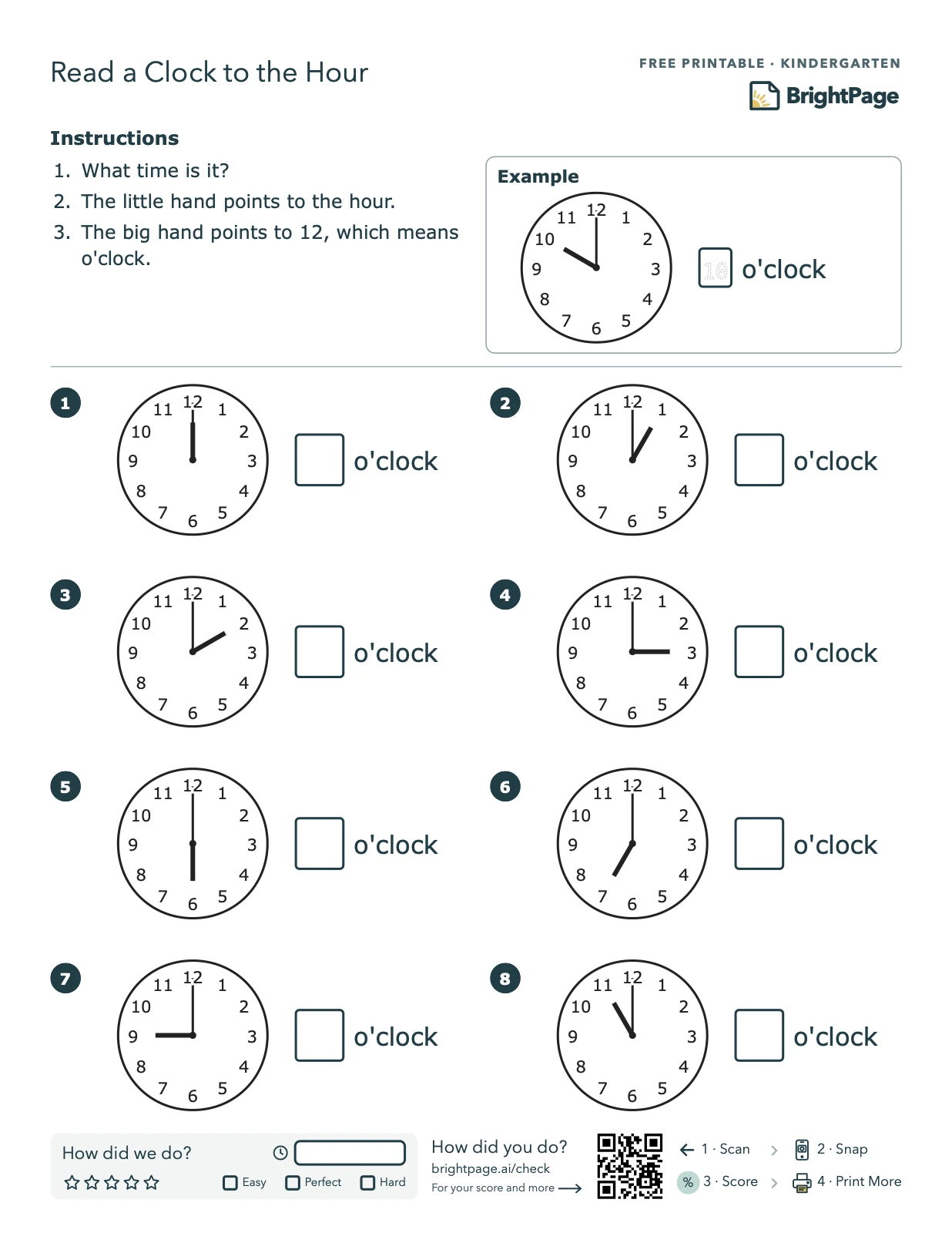
The hour: the long hand on 12, the short hand on the hour (Read a Clock to the Hour). Saying “little hand, hour” before each clock helps.From the sheet: The big hand points to 12. The little hand points to 3. What time is it? Answer: 3 o'clock 6:00
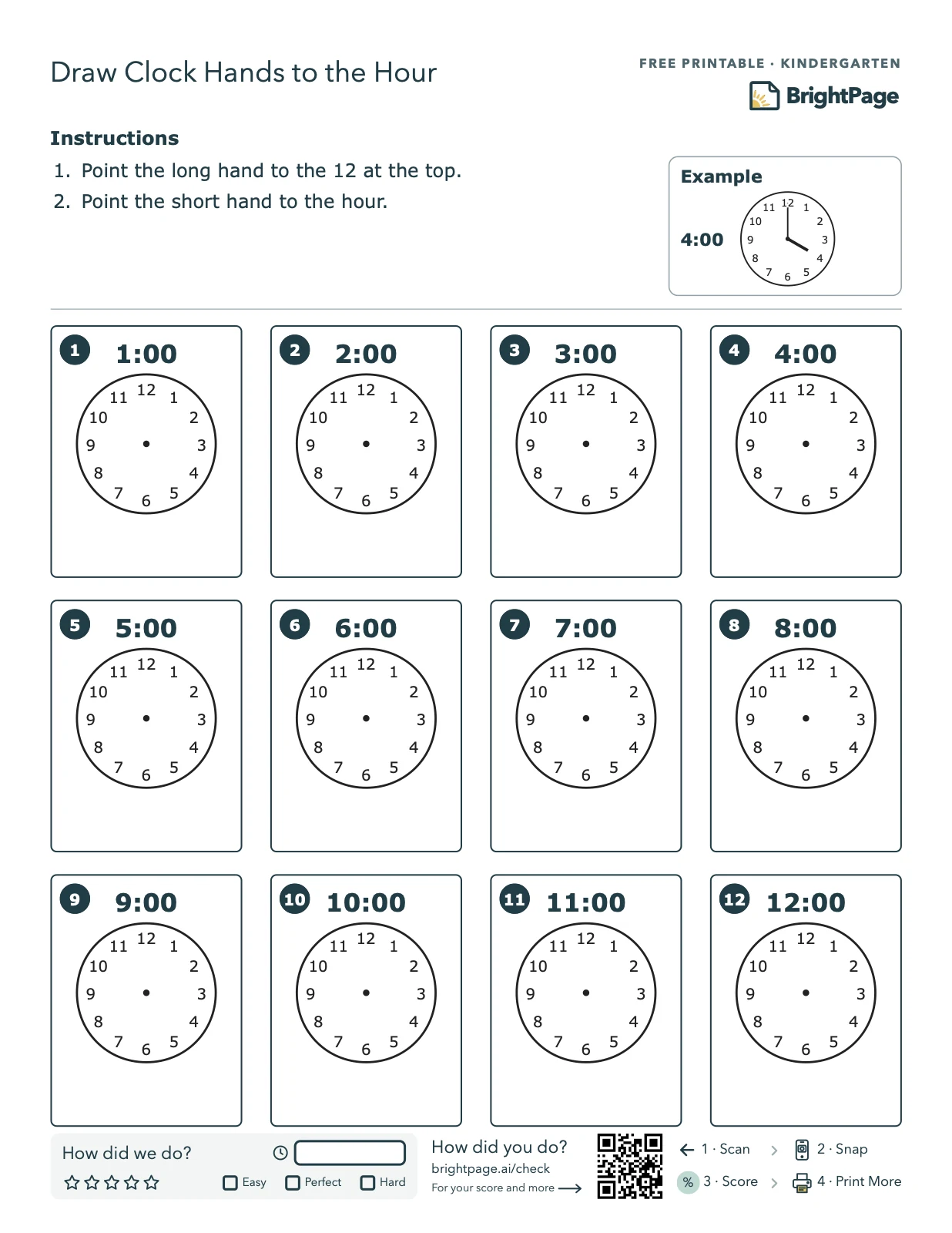
Drawing the hour: the long hand to 12 first, then a short hand that stops well before the numbers (Draw Clock Hands to the Hour).From the sheet: 6:00 Answer: Long hand to 12, short hand to 6. Half past 44:30
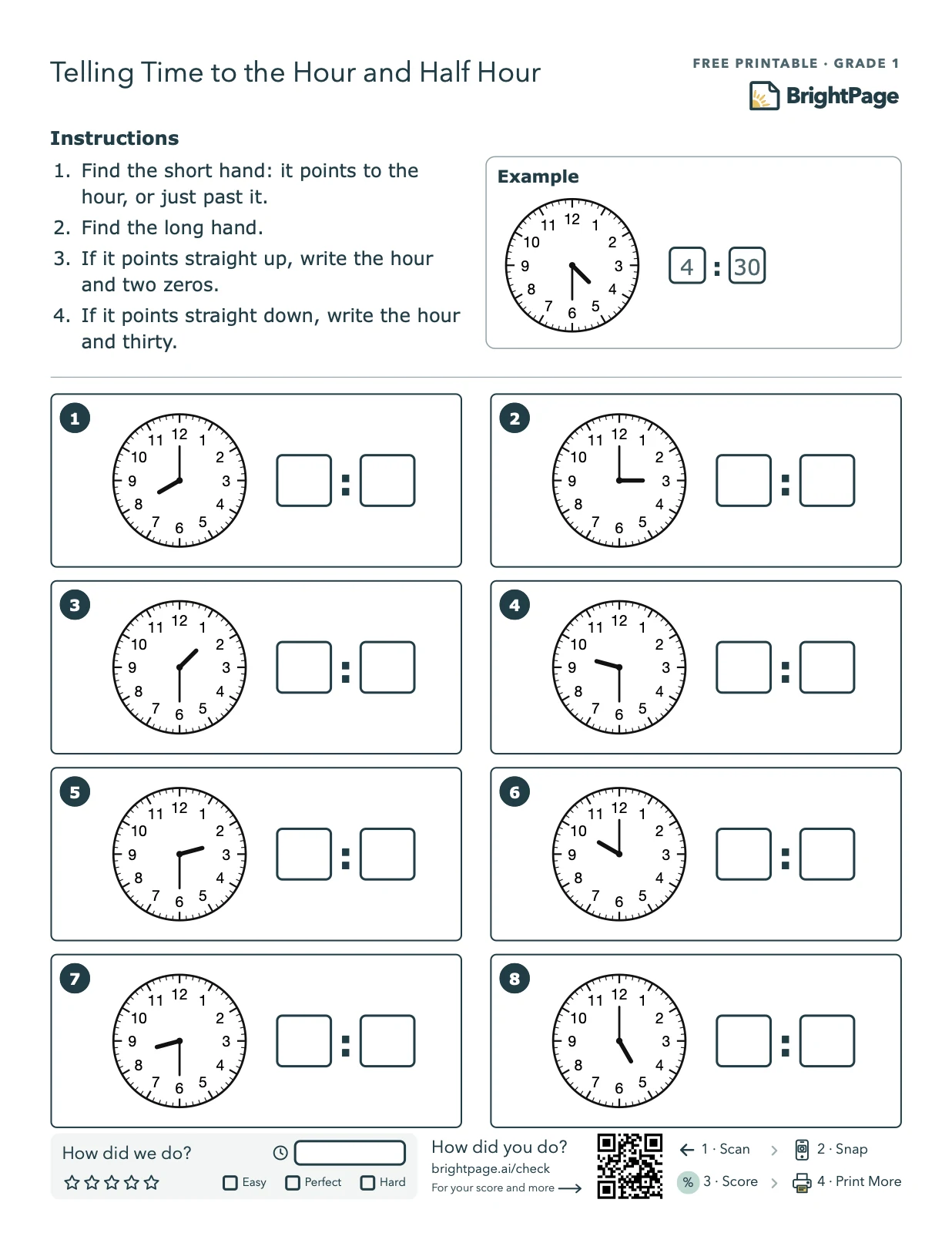
The half hour: the long hand straight down to 6 is half past, written :30. The short hand is now between two numbers (Telling Time to the Hour and Half Hour).From the sheet: The short hand is halfway between 4 and 5. The long hand points to 6. What time is it? Answer: 4:30 7:30
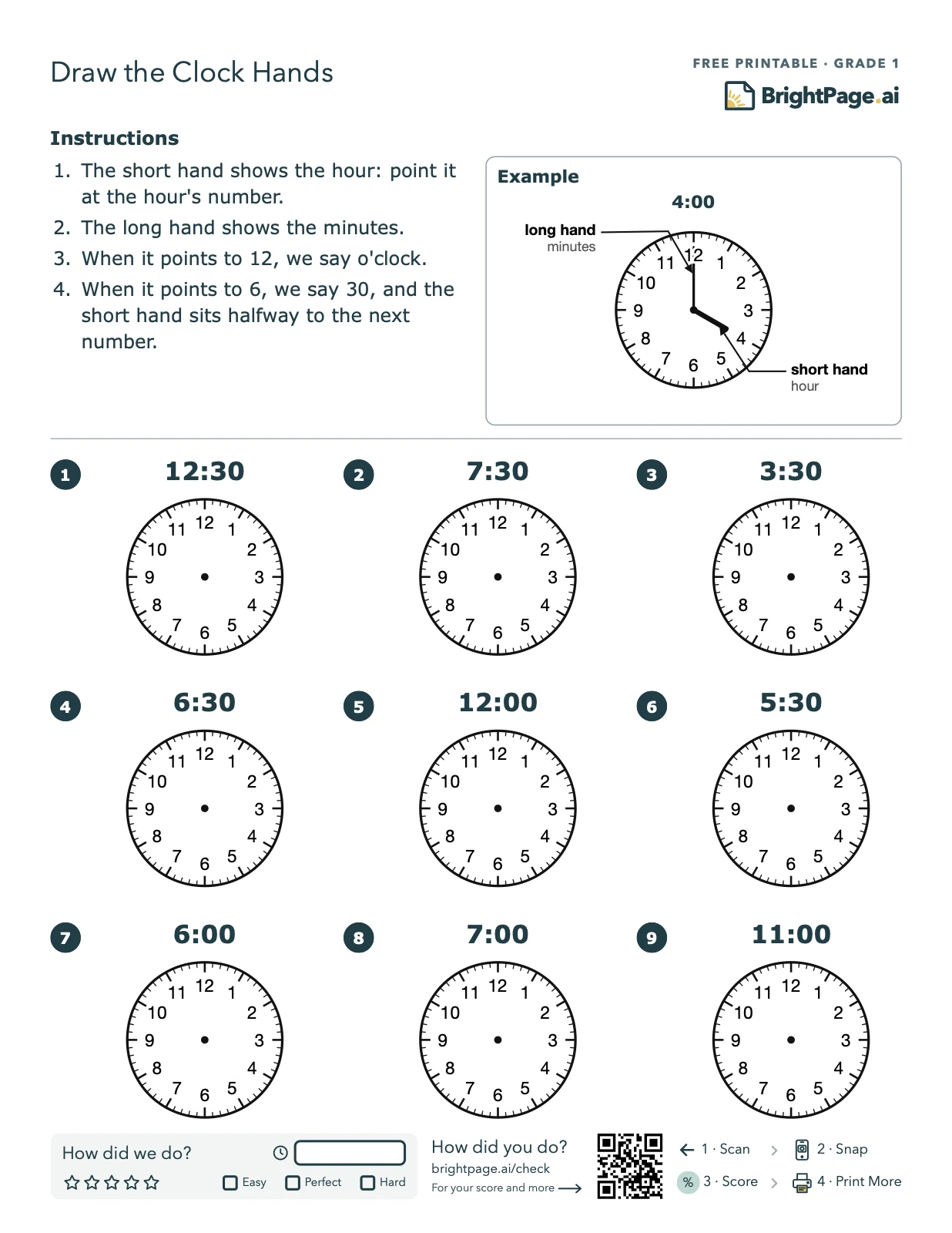
Drawing the half hour: half the hour has gone by, so the short hand has moved halfway to the next number (Draw the Clock Hands).From the sheet: Draw the hands to show 7:30. Answer: Long hand on the 6, short hand halfway between 7 and 8. 5, 10, 15 … 457:45
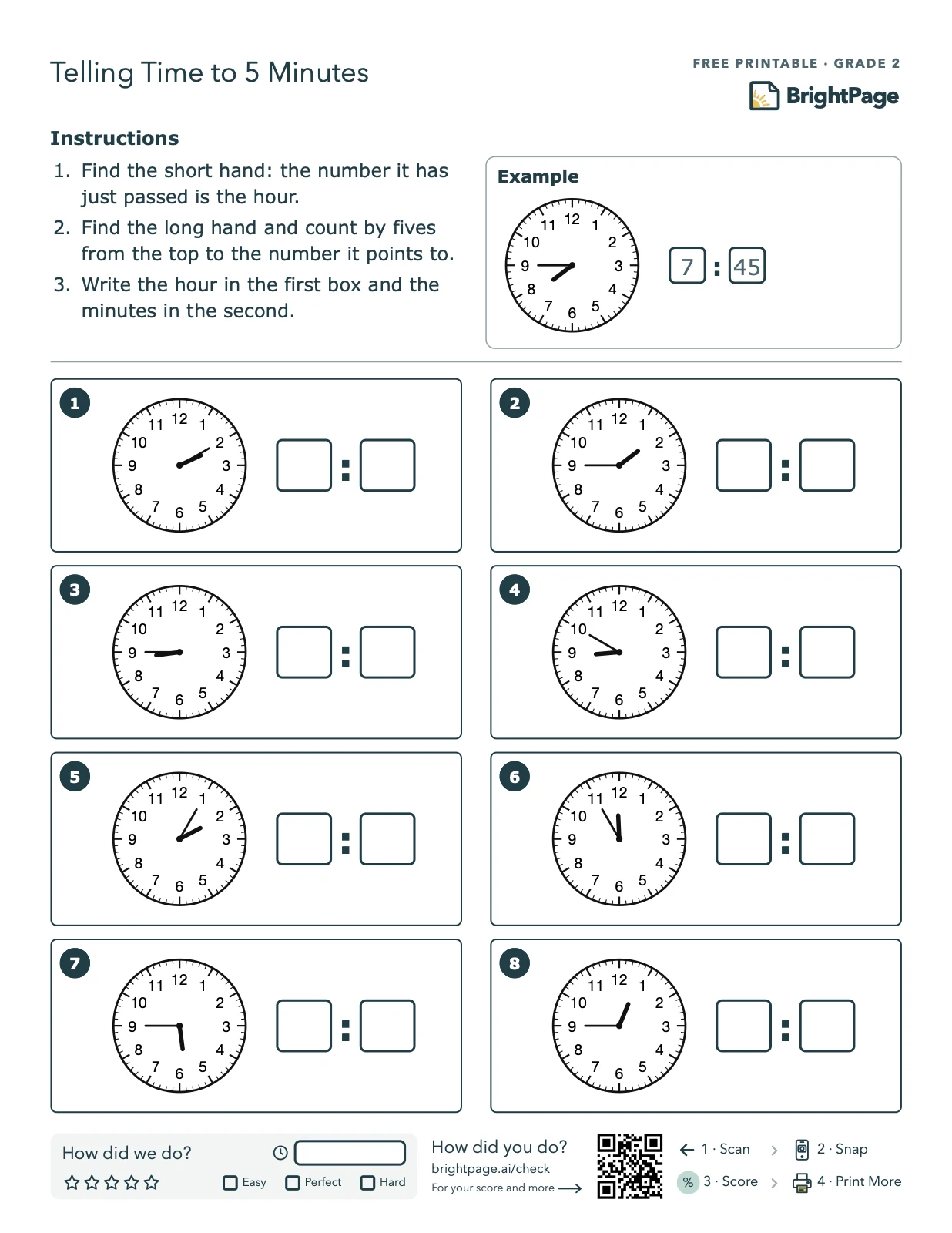
Five minutes: each number on the clock is five more minutes, so count by fives from the 12 to the long hand (Telling Time to 5 Minutes).From the sheet: The short hand is between 7 and 8. The long hand points to the 9. Answer: 7:45 25 by fives+ 1 = 2612:26
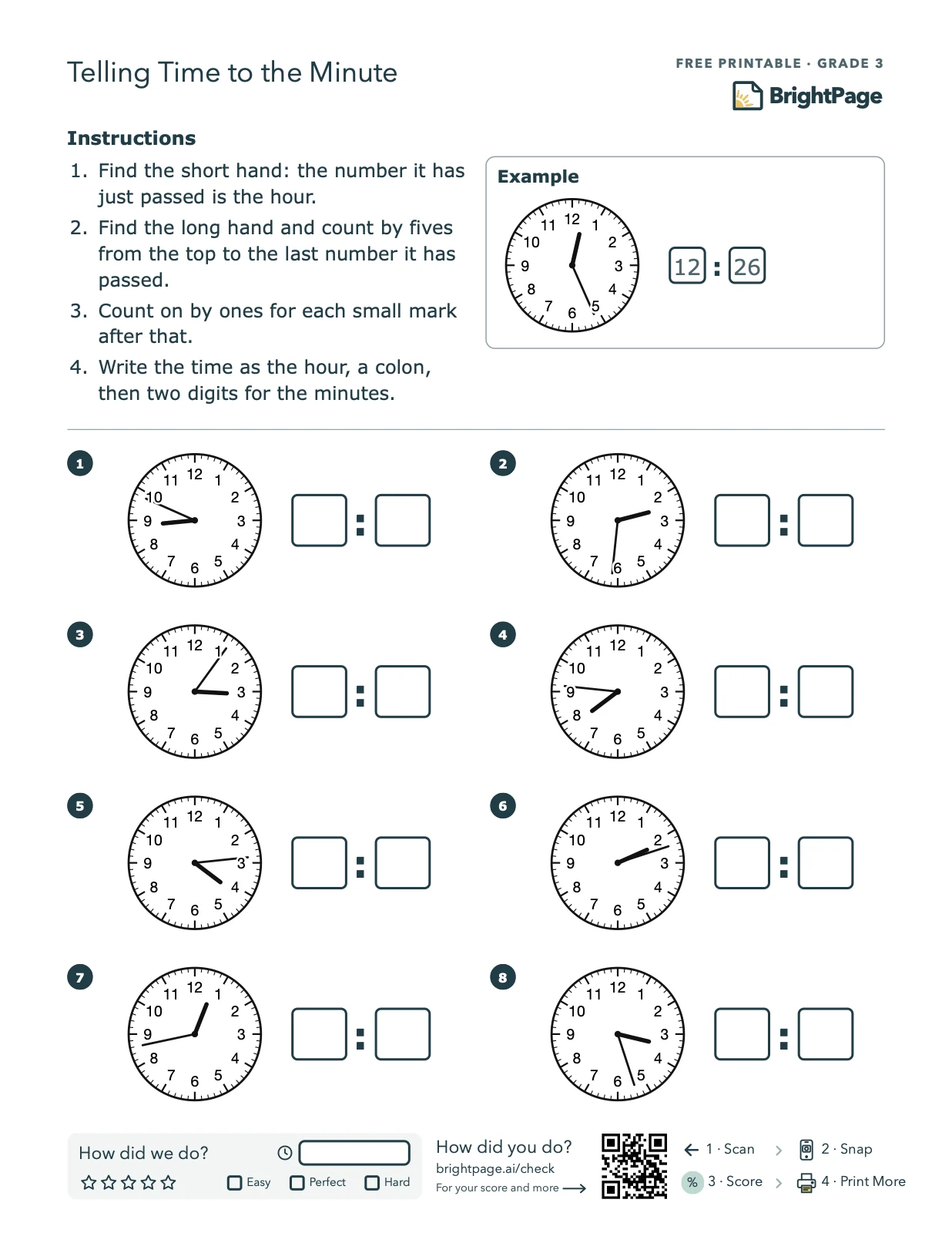
The exact minute: count by fives to the last number the long hand passed, then count on by ones (Telling Time to the Minute).From the sheet: The short hand is just past 12. The long hand is one mark past the 5. Answer: 12:26 7:50 → 8:00 is 108:00 → 8:10 is 1020 minutes
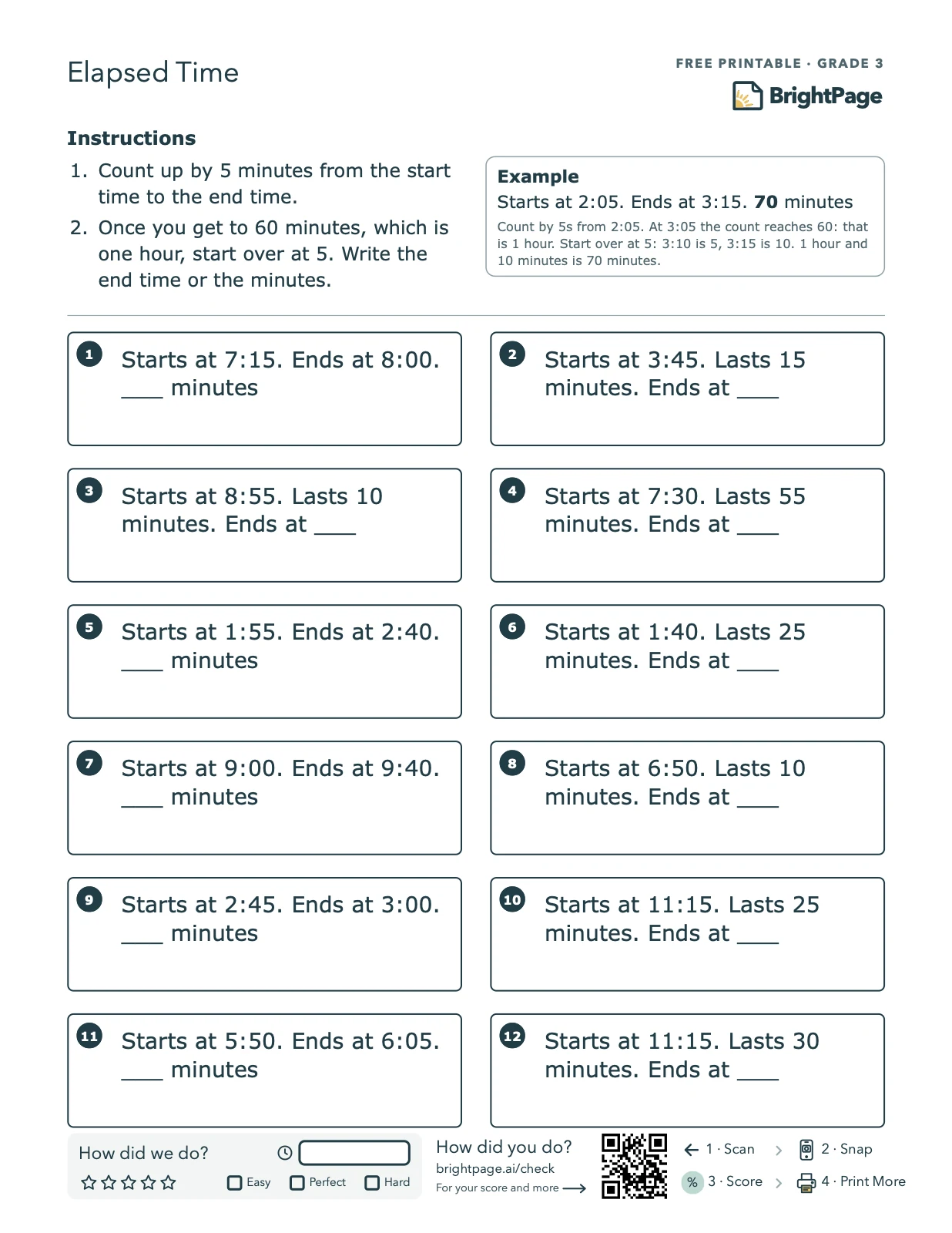
Elapsed time: how long from one time to another. Count up to the next hour, then count the rest (Elapsed Time).From the sheet: Starts at 2:05. Ends at 3:15. How many minutes? Answer: 70 minutes
Here is the half hour worked through, from a free printable:
A worked example
The short hand is halfway between 4 and 5. The long hand points to 6. What time is it?
- Find the short hand. It has passed 4 but not reached 5, so the hour is 4.
- Find the long hand. It points straight down to 6, so it is half past: 30 minutes.
- Write the hour, then the minutes: 4:30.
Answer: 4:30
The Mistake That Follows Kids From Grade to Grade
One mistake turns up at every step, so it is worth catching early. Late in the hour, the short hand is nearly at the next number, and children read that number: 4:30 becomes 5:30 in first grade, 7:45 becomes 8:45 in second, and 12:50 becomes 1:50 in third.
The fix is the same each time. The hour is the number the short hand has just passed, not the one it is closest to. Put a finger on it and say it out loud: “It has gone past 4. It hasn’t reached 5 yet.” Drawing the hands helps too, because a child who has to place the short hand halfway to the next number for 7:30 sees why it isn’t pointing at the 7 any more.
Count by Fives, Then Count On
The minute hand is a counting job. A child who can count by fives can read it: start at the 12 and say “5, 10, 15” at each number until the long hand is reached. To the exact minute, count by fives to the last number the hand passed, then count on by ones for each little line after it. No one needs to memorize that the 9 means 45; counting gets there, and the shortcuts come with practice.
Elapsed Time: Count Up to the Hour
Elapsed time is where the clock stops behaving like other numbers. Children add minutes the way they add anything else, so 7:50 and 20 minutes more becomes 7:70. An hour has only 60 minutes. Counting up avoids it: from 7:50 to 8:00 is 10 minutes, and the 10 left over take it to 8:10. For a longer stretch, count by fives from the start, and each time the count reaches 60, that is one hour.
Make It Part of the Day
A page builds the skill; the day gives it a reason. A few ways to fit it in:
- Put an analog clock where your child can see it from the kitchen table.
- Ask at real moments: “What time is it now? Dinner is at 6:00. How long until then?”
- Let your child draw the hands for something coming up, like the time a friend arrives.
- Read the time out loud the long way now and then (“half past four”), so the words and the clock go together.
Which Skills by Which Grade?
Under the Common Core, which many states’ standards follow, first graders tell and write time in hours and half hours on analog and digital clocks (1.MD.B.3). Second graders read to the nearest five minutes and use a.m. and p.m. (2.MD.C.7). Third graders read to the nearest minute and solve problems about how many minutes pass (3.MD.A.1). Clocks aren’t in the kindergarten standards, but many kindergartens start the hour, and our kindergarten sheets do too. Check these against your school’s own standards.
How BrightPage Does It
Telling time is a lesson in BrightPage’s math course in each grade from kindergarten to third: the hour in kindergarten, the hour and half hour in first grade, five minutes and a.m. and p.m. in second, and the exact minute and elapsed time in third. Your child reads clocks and draws the hands in pencil, you photograph the page, and AI scores it. From first grade, once your child has it, time is reviewed at longer and longer gaps, so it isn’t forgotten between units. The research behind each step is on our learning-science page.
Free Printables for This
Print one, and your child works it in pencil. Each has a worked example on its page.
More Questions Parents Ask
At what age do kids learn to tell time?
Under the Common Core, which many states' standards follow, children read the hour and half hour in first grade (about age 6 or 7), the nearest five minutes in second grade, and the exact minute in third grade. Many kindergartens look at the hour first. Check your school's own standards, since they can differ.
Should my child learn on a digital or an analog clock?
Both. A digital clock can be read off as two numbers, but an analog clock shows how an hour is built and how much of it has gone by, which is what elapsed time needs later. The standards ask for both from first grade. Start on the analog clock and write the time the digital way beside it.
Why does my child read 4:30 as 5:30?
At half past, the short hand sits halfway between the 4 and the 5, and children read the number it is pointing toward. The hour is the number the short hand has just passed. Point to it and say: it has gone past 4, it hasn't reached 5 yet.
How do I explain a.m. and p.m.?
A.m. is the time from midnight to noon, so breakfast and the walk to school. P.m. is noon to midnight, so lunch, dinner and bedtime. Children learn them in second grade. Ask about real moments in the day: is dinner at 6 a.m. or 6 p.m.?
How do I teach elapsed time?
Count up from the start time to the next hour, then count the rest. From 7:50 to 8:10 is 10 minutes to 8:00 and 10 more, so 20 minutes. Counting up keeps a child from adding minutes as if an hour had 100 of them, which is how 7:50 plus 20 minutes becomes 7:70.
The Research
- Common Core State Standards for Mathematics, Grade 1: Measurement and Data (1.MD.B.3). thecorestandards.org/Math/Content/1/MD/
- Common Core State Standards for Mathematics, Grade 2: Measurement and Data (2.MD.C.7). thecorestandards.org/Math/Content/2/MD/
- Common Core State Standards for Mathematics, Grade 3: Measurement and Data (3.MD.A.1). thecorestandards.org/Math/Content/3/MD/