
How Do I Teach My Child Equivalent Fractions?
The short answer
Start with a picture: shade 3/4 of a bar, then cut each piece into three and the same shading is 9/12. Equivalent fractions are the same amount cut into different-sized pieces. Once that makes sense, teach the rule: multiply (or divide) the top and the bottom by the same number. Never add the same number to both, which changes the amount.

By Caitlin Damani, Founder, BrightPage · Reviewed · 6 min read
Why Fractions Are Worth the Time
Fractions are where many children first find that numbers don’t always behave the way whole numbers taught them to. They matter well beyond the unit, too. In a study that followed students in the United States and the United Kingdom, what children knew about fractions and division in elementary school predicted their algebra and overall math achievement in high school, five or six years later, even after accounting for their other math knowledge, general ability and family background (Siegler and colleagues, 2012).
Picture First, Then the Rule
Equivalent fractions name the same amount with different numbers. Shade 3/4 of a bar, then cut every piece into three: the bar now has 12 pieces and 9 of them are shaded, but the shading hasn’t moved. Nothing was added; the pieces just got smaller.
Same amount,smaller pieces
Starting with something a child can see, and moving to the numbers once the picture makes sense, is a well-tested way into an abstract idea in math (Fyfe and colleagues, 2014). The rule then describes what the picture already showed: multiplying the top and the bottom by 3 is cutting every piece into three. A child who learns the rule first has nothing to check it against, which is how 3/4 turns into 11/12.
Build Up to It
Equivalent fractions rest on a few ideas that come before them, and they open up the ones that come after:
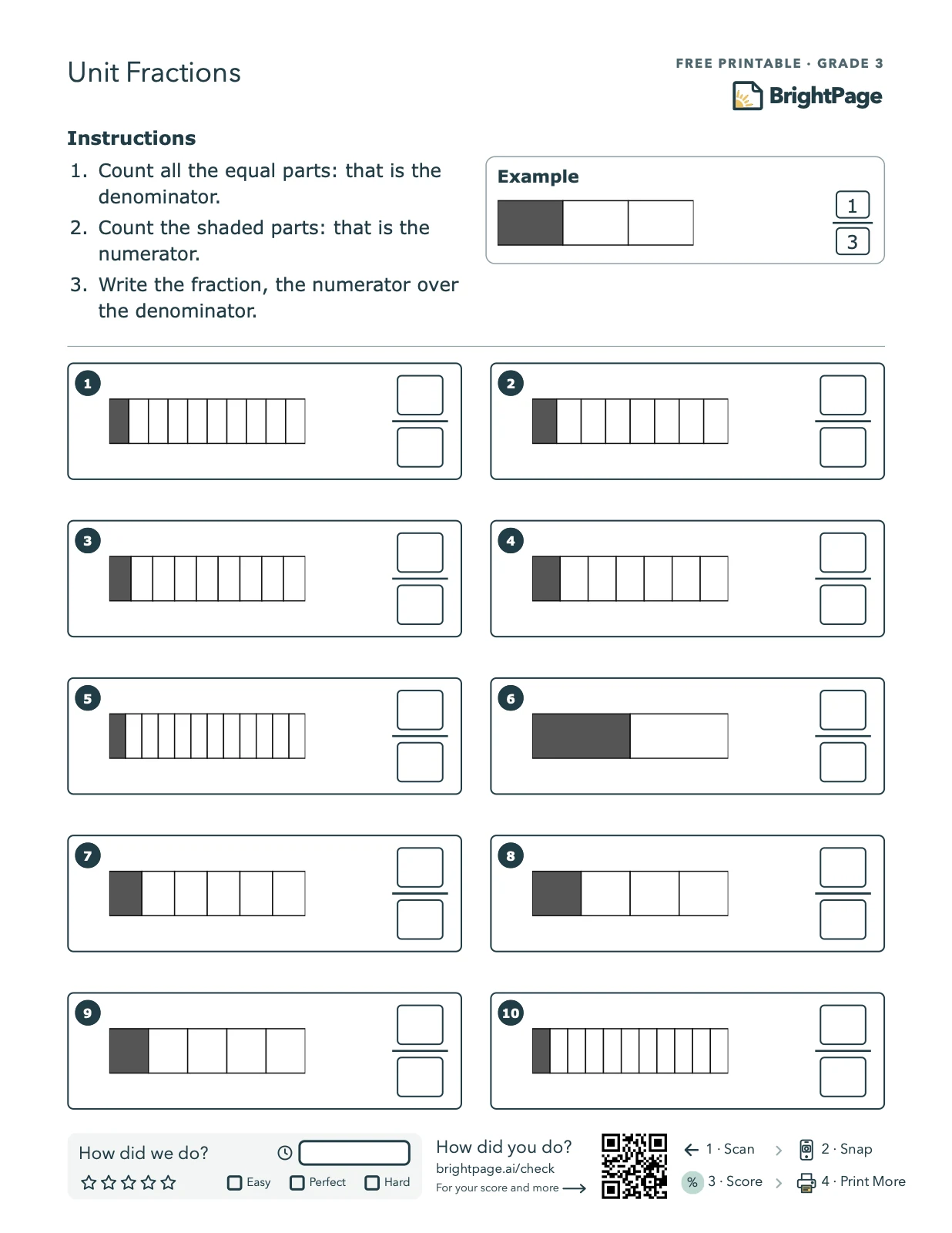
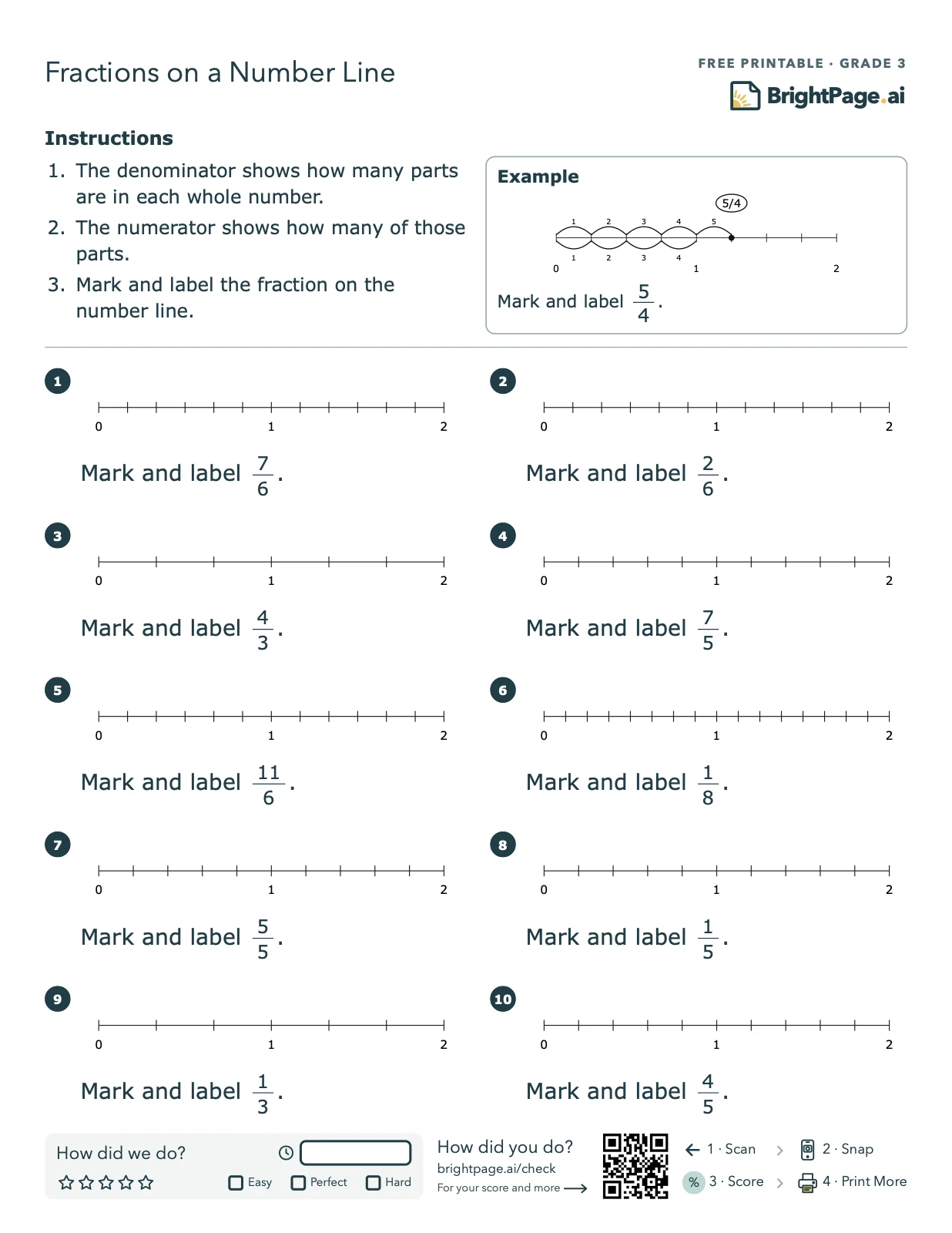
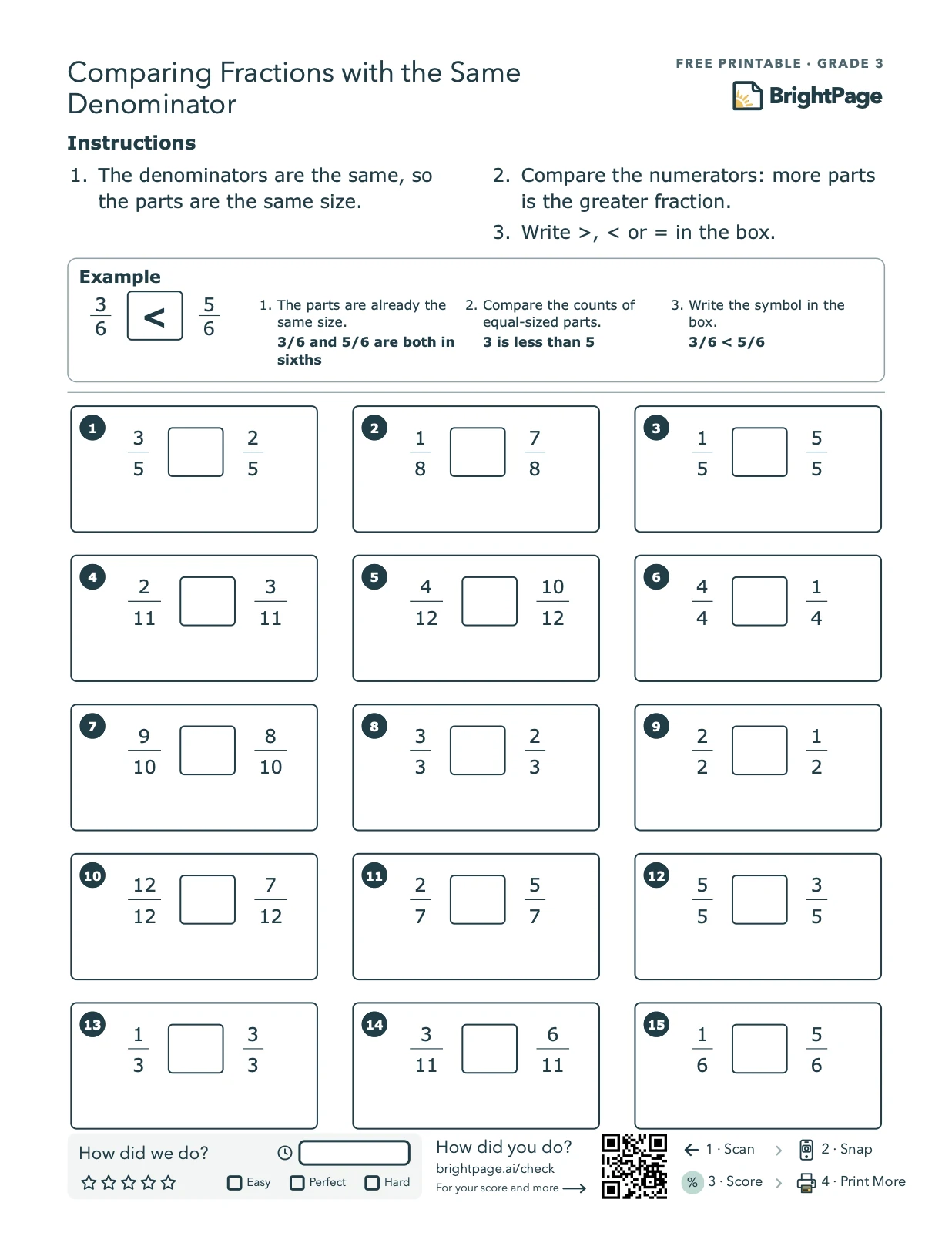
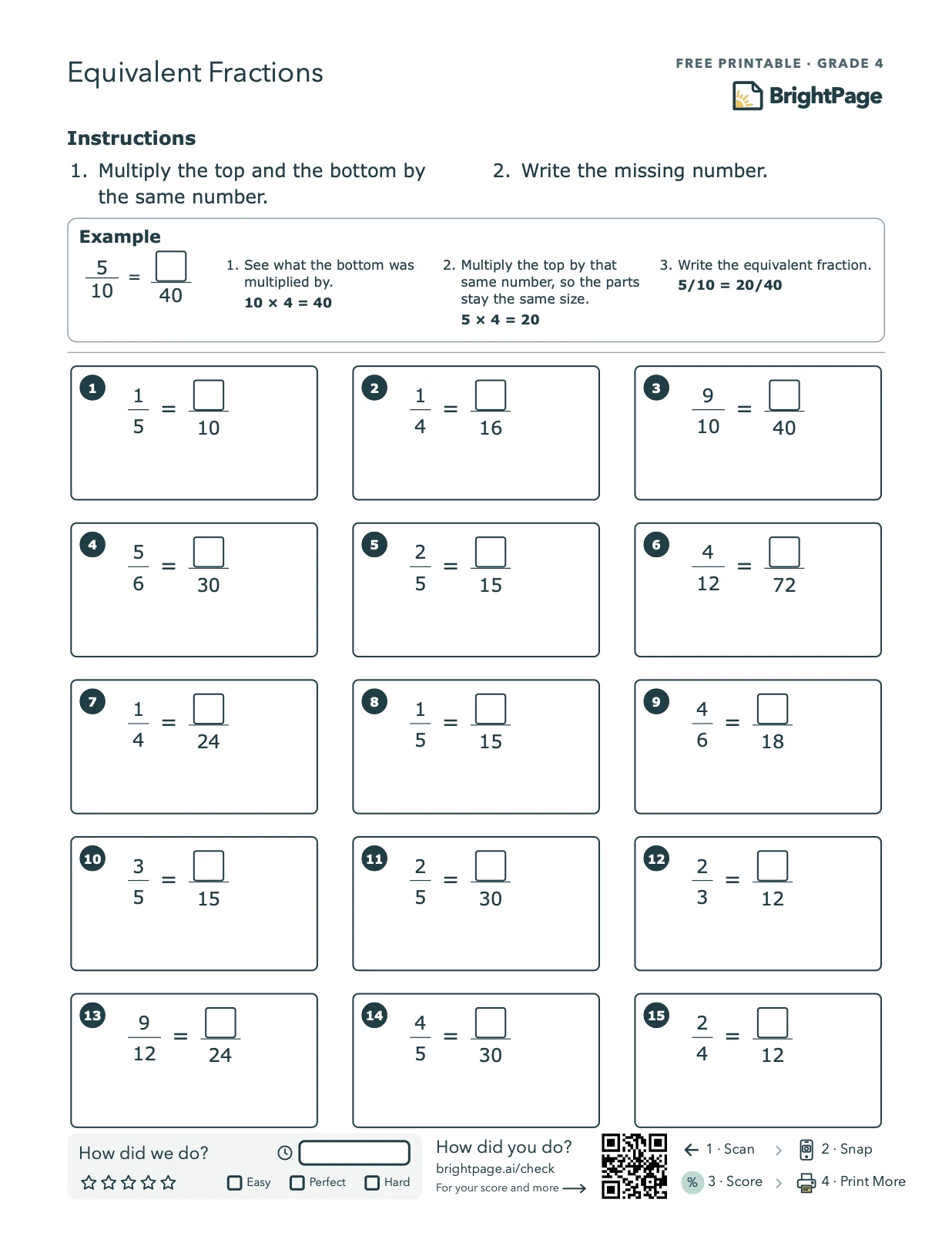
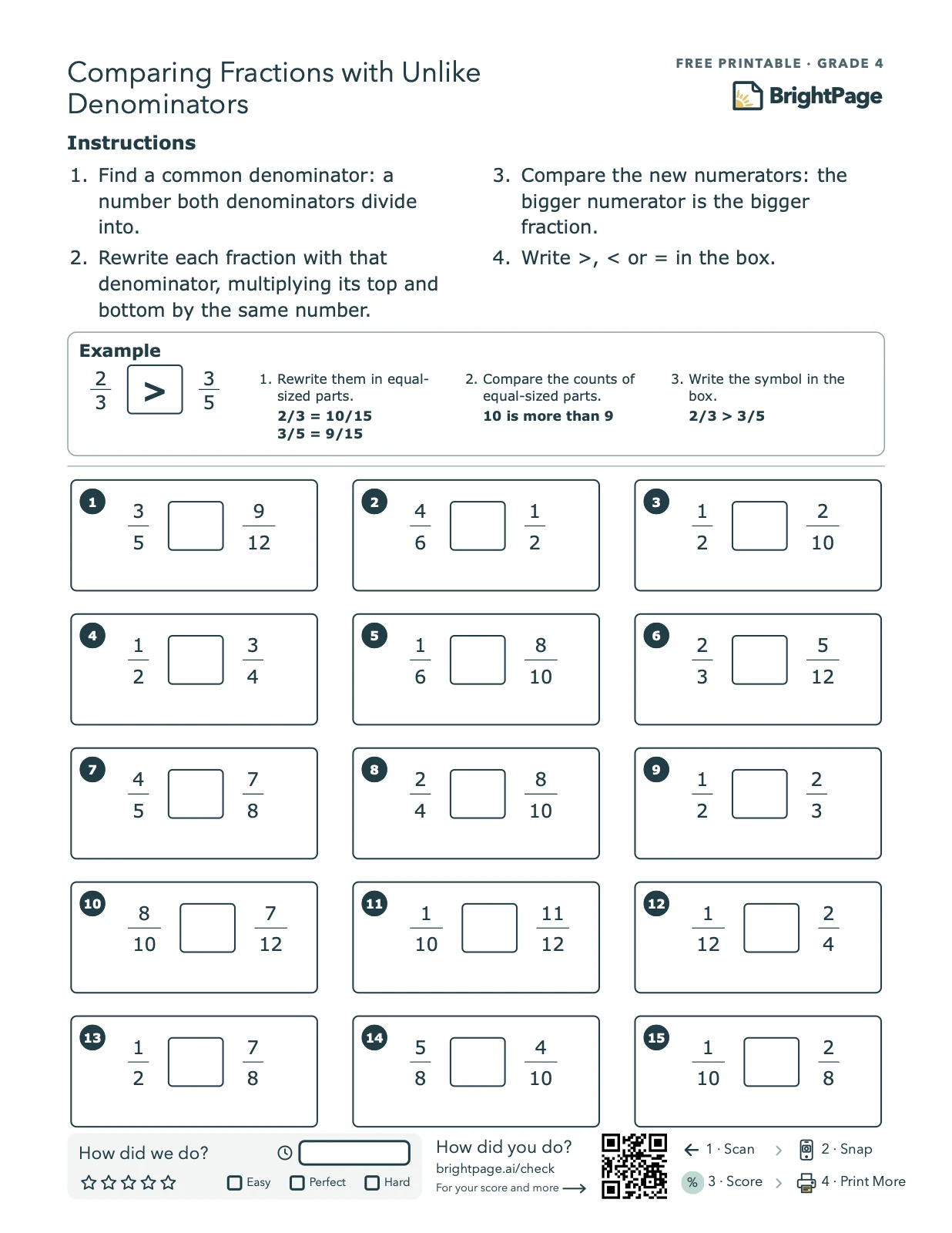
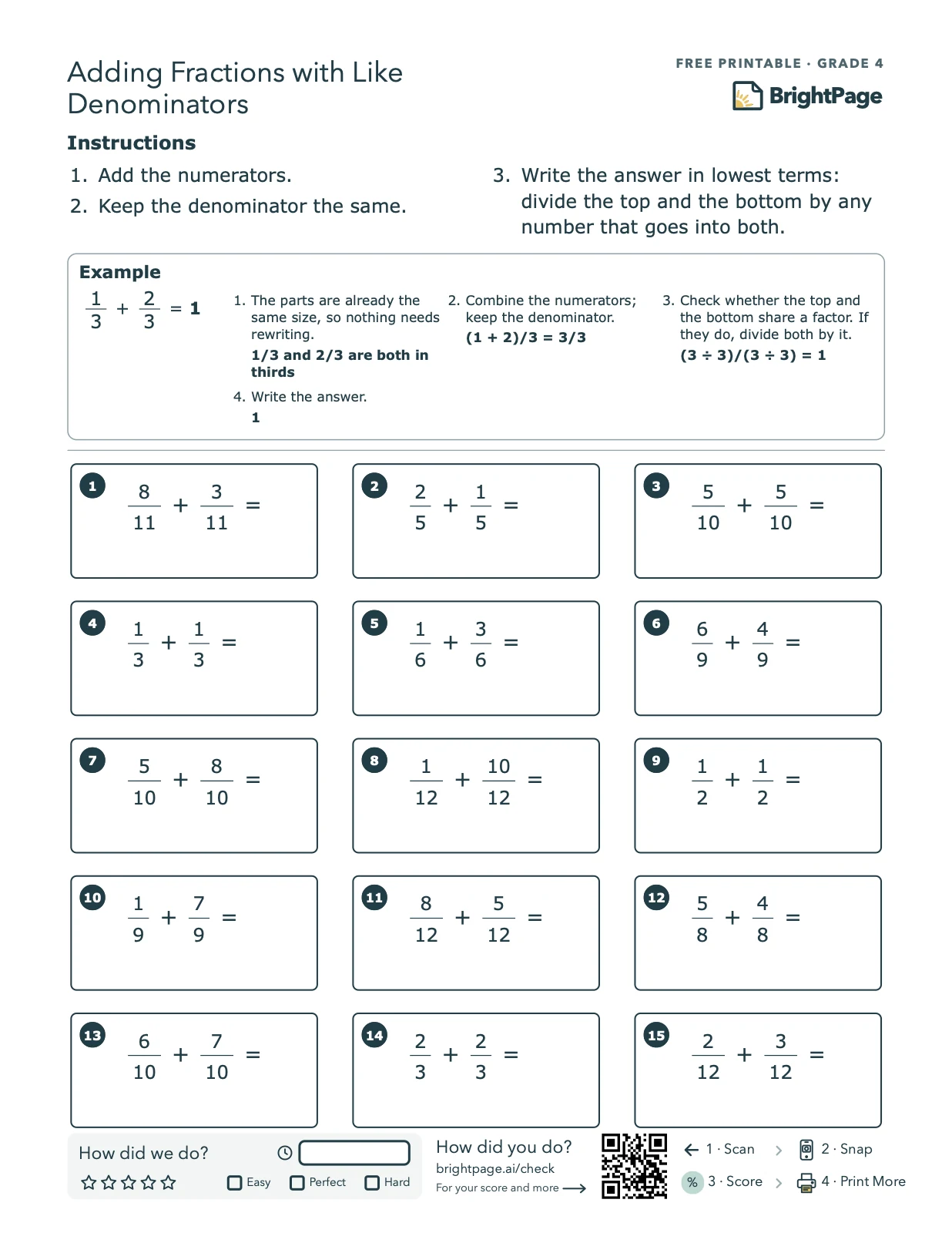
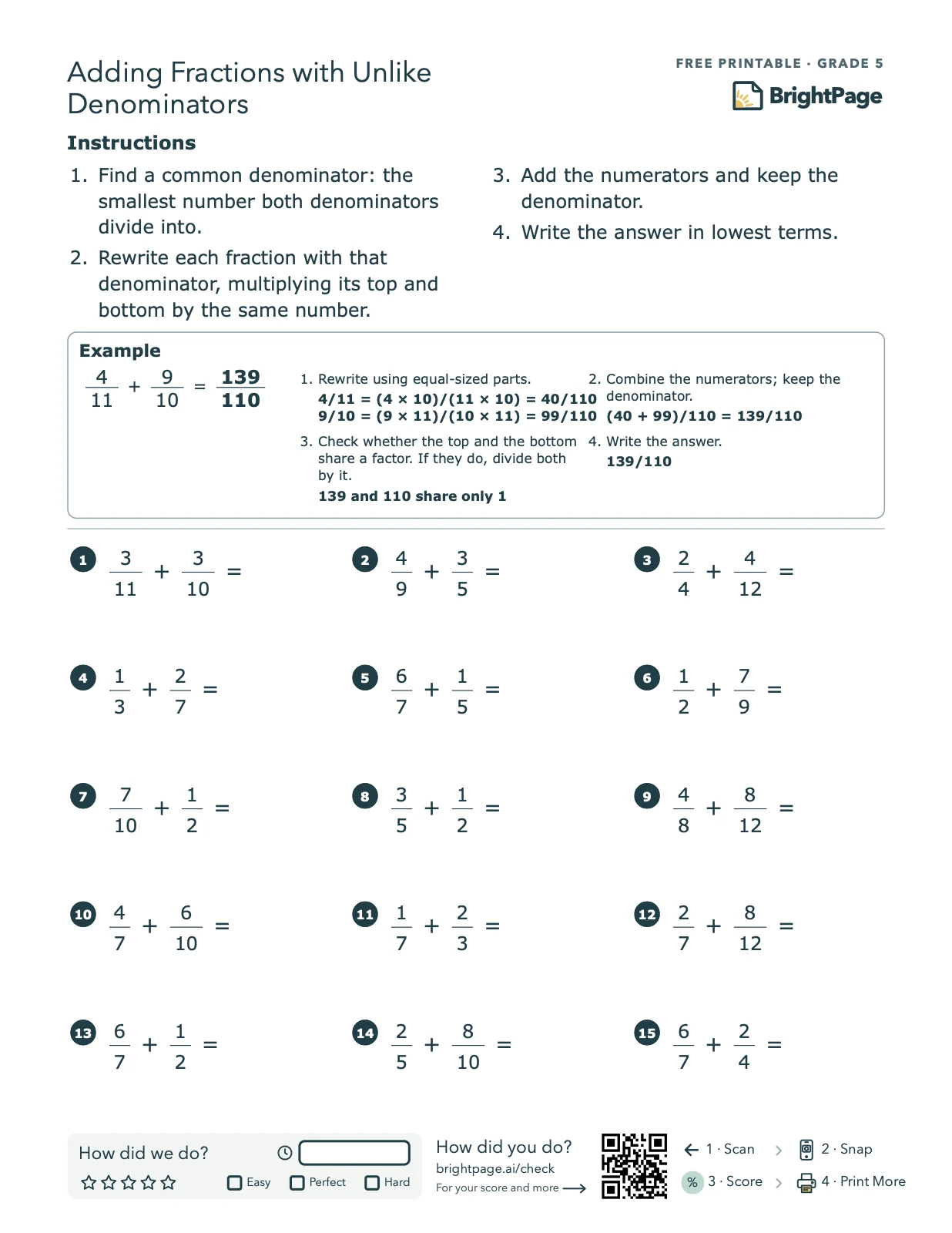
Unit fractions: the bottom number counts every equal part, shaded or not (Unit Fractions).From the sheet: A bar is cut into 3 equal parts and 1 is shaded. What fraction is shaded? Answer: 1/3 Fractions on a number line: a fraction is a distance from 0, so 5/4 is one fourth past 1 (Fractions on a Number Line).From the sheet: Plot and label 5/4. Answer: A dot one part past 1, labeled 5/4. Comparing with the same denominator: the pieces are the same size, so more pieces is more (Comparing Fractions with the Same Denominator).From the sheet: 3/6 ___ 5/6 Answer: < Equivalent fractions: multiply the top and the bottom by the same number (Equivalent Fractions).From the sheet: 3/4 = ?/12 Answer: 9 Comparing with different denominators: rewrite both in the same size of piece first (Comparing Fractions with Unlike Denominators).From the sheet: 3/4 ___ 5/6 Answer: 3/4 < 5/6 Adding with like denominators: add the pieces and keep their size, then simplify: 4/8 is 1/2 (Adding Fractions with Like Denominators).From the sheet: 3/8 + 1/8 = ? Answer: 3/8 + 1/8 = 1/2 Adding with unlike denominators: equivalent fractions make the pieces the same size, then add (Adding Fractions with Unlike Denominators).From the sheet: 1/3 + 1/4 = ? Answer: 1/3 + 1/4 = 7/12
Here is the rule worked through, from a free printable:
A worked example
3/4 = ?/12
- See what the bottom was multiplied by: 4 × 3 = 12.
- Multiply the top by the same number: 3 × 3 = 9.
- Write the equivalent fraction: 3/4 = 9/12.
Answer: 9
The Mistakes All Come From Whole Numbers
Almost every fraction mistake is a whole-number habit applied where it doesn’t fit. Three turn up again and again on the sheets:
- Adding to the top and bottom: 3/4 = 11/12. Adding feels like “doing the same to both”, but it changes the amount.
- Bigger denominator, bigger fraction: deciding 3/8 is more than 1/2 because 8 is more than 2. A bigger denominator means smaller pieces.
- Adding the bottoms too: 1/3 + 1/4 = 2/7. The answer is smaller than 1/3, which can’t be right for adding something to it.
The fix is the same each time: check the answer against a picture or a benchmark. Is it more or less than a half? More or less than a whole? 11/12 is almost a whole, so it can’t be three quarters, and 2/7 is less than a third, so it can’t be a third plus a quarter. A child who estimates first catches most of these alone.
Fractions You Can Fold and Eat
A few ways to bring the picture home:
- Fold a strip of paper in half, then in half again. Color one half, and count how many fourths it covers.
- Cut a sandwich into fourths, then each fourth in half. Ask how many eighths make the half your child is about to eat.
- Use measuring cups: two 1/4 cups fill the 1/2 cup, which is 2/4 = 1/2 you can pour.
Which Skills by Which Grade?
Under the Common Core, which many states’ standards follow, third graders learn that a fraction is made of equal parts, place fractions on a number line, and find simple equivalent fractions such as 1/2 = 2/4, explaining them with a picture (3.NF.A.1–3). Fourth graders explain why multiplying the top and bottom by the same number gives an equivalent fraction, and compare fractions with different denominators (4.NF.A.1–2). Fifth graders use equivalent fractions to add and subtract fractions with unlike denominators (5.NF.A.1). Check these against your school’s own standards.
How BrightPage Does It
Fractions are a unit of BrightPage’s math course from third grade to fifth: unit fractions, comparing and simple equivalent fractions in third grade; equivalent fractions by multiplying or dividing, comparing different denominators, and adding and subtracting like denominators in fourth; and adding and subtracting different denominators in fifth. Each page comes with its instructions and a worked example, your child works it in pencil, you photograph it, and AI scores it. A topic your child has learned is reviewed at longer and longer gaps, so fourths and twelfths are still there when fifth grade needs them. The research behind each step is on our learning-science page.
Free Printables for This
Print one, and your child works it in pencil. Each has a worked example on its page.
More Questions Parents Ask
What are equivalent fractions?
Fractions that name the same amount with different numbers. 1/2, 2/4 and 4/8 are all half of the same whole, cut into 2, 4 or 8 equal pieces. On a number line they land on the same point.
How do you find an equivalent fraction?
Multiply the top and the bottom by the same number: 3/4 × 3/3 is 9/12. Dividing both by the same number works too: 8/12 ÷ 4/4 is 2/3. Either way every piece is cut smaller or joined into bigger ones, so the amount stays the same.
Why can't you add the same number to the top and bottom?
Because adding changes the amount. Add 8 to the top and bottom of 3/4 and you get 11/12, which is almost a whole, while 3/4 is three quarters. Multiplying keeps the same share of the whole; adding doesn't.
What grade learns equivalent fractions?
Under the Common Core, third graders find simple equivalent fractions such as 1/2 = 2/4 and explain them with a picture. Fourth graders explain the rule of multiplying the top and bottom by the same number, and fifth graders use it to add fractions with different denominators. Check your school's own standards, since they can differ.
How do I simplify a fraction?
Divide the top and the bottom by a number that goes into both. 4/8 becomes 1/2 by dividing both by 4. It is the same idea as finding an equivalent fraction, run the other way: bigger pieces, fewer of them.
The Research
- Siegler, R. S., et al. (2012). Early predictors of high school mathematics achievement. Psychological Science, 23(7). doi.org/10.1177/0956797612440101
- Fyfe, E. R., McNeil, N. M., Son, J. Y., & Goldstone, R. L. (2014). Concreteness fading in mathematics and science instruction: A systematic review. Educational Psychology Review, 26(1). doi.org/10.1007/s10648-014-9249-3
- Common Core State Standards for Mathematics, Grade 3: Number and Operations—Fractions (3.NF.A.1–3). thecorestandards.org/Math/Content/3/NF/
- Common Core State Standards for Mathematics, Grade 4: Number and Operations—Fractions (4.NF.A.1, 4.NF.A.2). thecorestandards.org/Math/Content/4/NF/
- Common Core State Standards for Mathematics, Grade 5: Number and Operations—Fractions (5.NF.A.1). thecorestandards.org/Math/Content/5/NF/