
Subtraction with Regrouping: How to Teach It and Why Kids Get Stuck
The short answer
Kids usually get stuck on subtraction with regrouping (also called borrowing) for one of two reasons. Either they subtract the smaller digit from the bigger one in each column, so 52 − 27 becomes 35, or they don't yet understand that one ten can be swapped for ten ones. Start with blocks or drawings so the swap makes sense. Then teach three rules: always subtract the bottom number from the top, regroup when the top digit is smaller, and check by adding back.

By Caitlin Damani, Founder, BrightPage · Reviewed · 6 min read
What Regrouping Means
When the top digit in a column is smaller than the bottom digit, you can't subtract yet. In 52 − 27, you can't take 7 from 2. So you take one ten from the tens column and turn it into ten ones. 52 becomes 4 tens and 12 ones. It's still 52, just written differently, and now 12 − 7 works.
Step by Step
Top Mistakes Children Make
They take the smaller digit from the larger one. For 52 − 27, the child does 7 − 2 = 5 in the ones and 5 − 2 = 3 in the tens, and writes 35. “Take the small one from the big one” works for single facts, so it gets applied to every column, whatever the order. Adding back exposes it: 35 + 27 is 62, not 52.
The mistake
Check by adding back
A ten isn’t ten ones to them yet. If your child sees 52 as just "a 5 and a 2," crossing out the 5 and writing a 4 is a magic trick they have to memorize, and memorized tricks fall apart under pressure. A child who has built 52 out of blocks and traded a rod for ten cubes knows why the 5 becomes a 4, and that sticks.
Zeros in the top number. Zeros are the hardest part, because you can't borrow from nothing. In 700 − 258, the tens column is 0, so keep moving left until you reach a digit that can lend. The 7 hundreds become 6 hundreds and 10 tens, and then one of those tens becomes 10 ones. Now you have 6 hundreds, 9 tens and 10 ones, still 700, and every column can be subtracted. The answer is 442. Most kids are ready for this a little later, so practice it on its own.
For older kids: bigger numbers
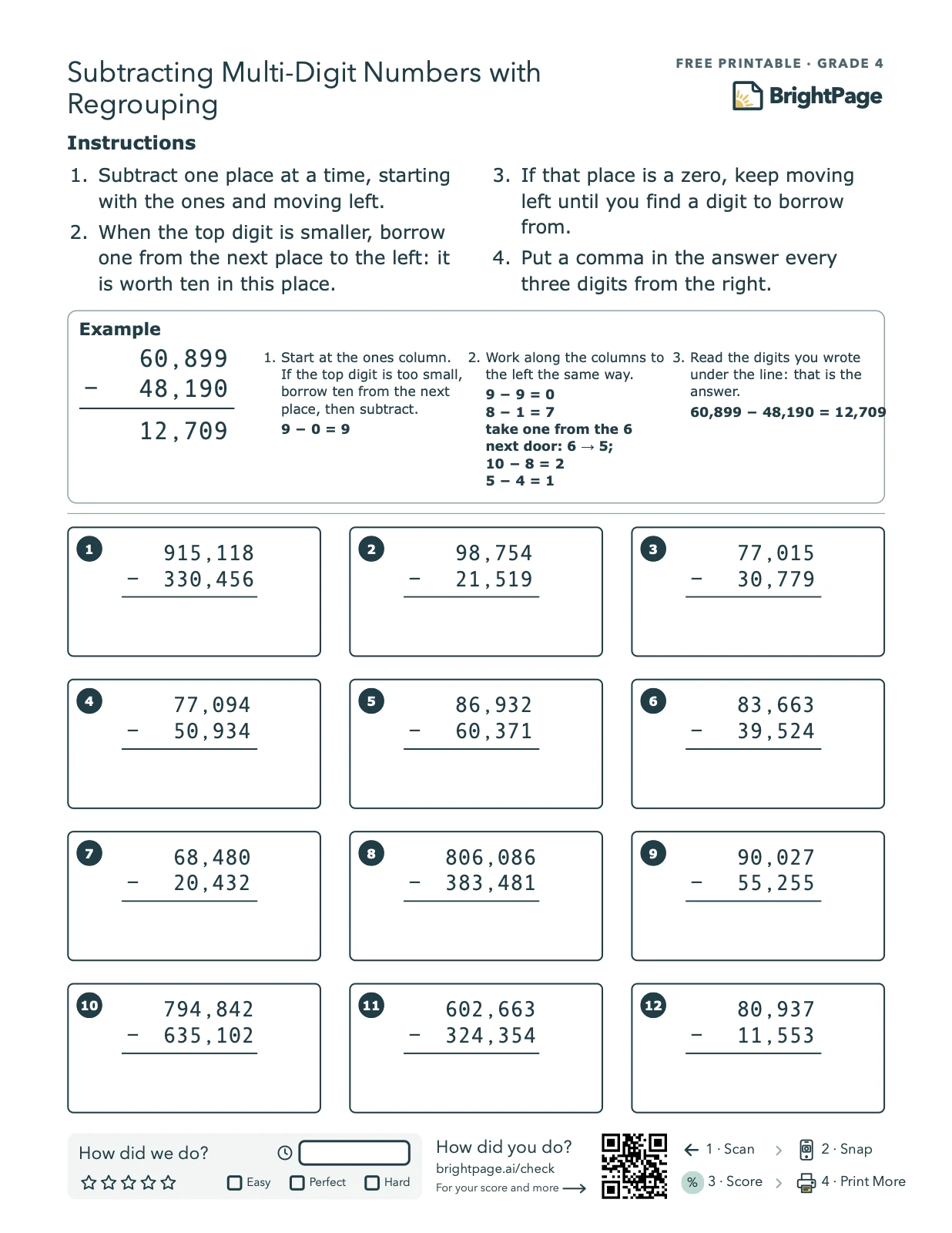
The same steps work for any size of number. Here is 70,015 − 32,408 (Subtracting Multi-Digit Numbers with Regrouping), worked step by step.
Step by Step
What to Practice, in Order
Start with something your child can touch, move to a drawing, and only then use numbers alone. Research supports this order: it helps kids carry an idea from real objects to written math (Fyfe and colleagues, 2014).
- 343tens4ones
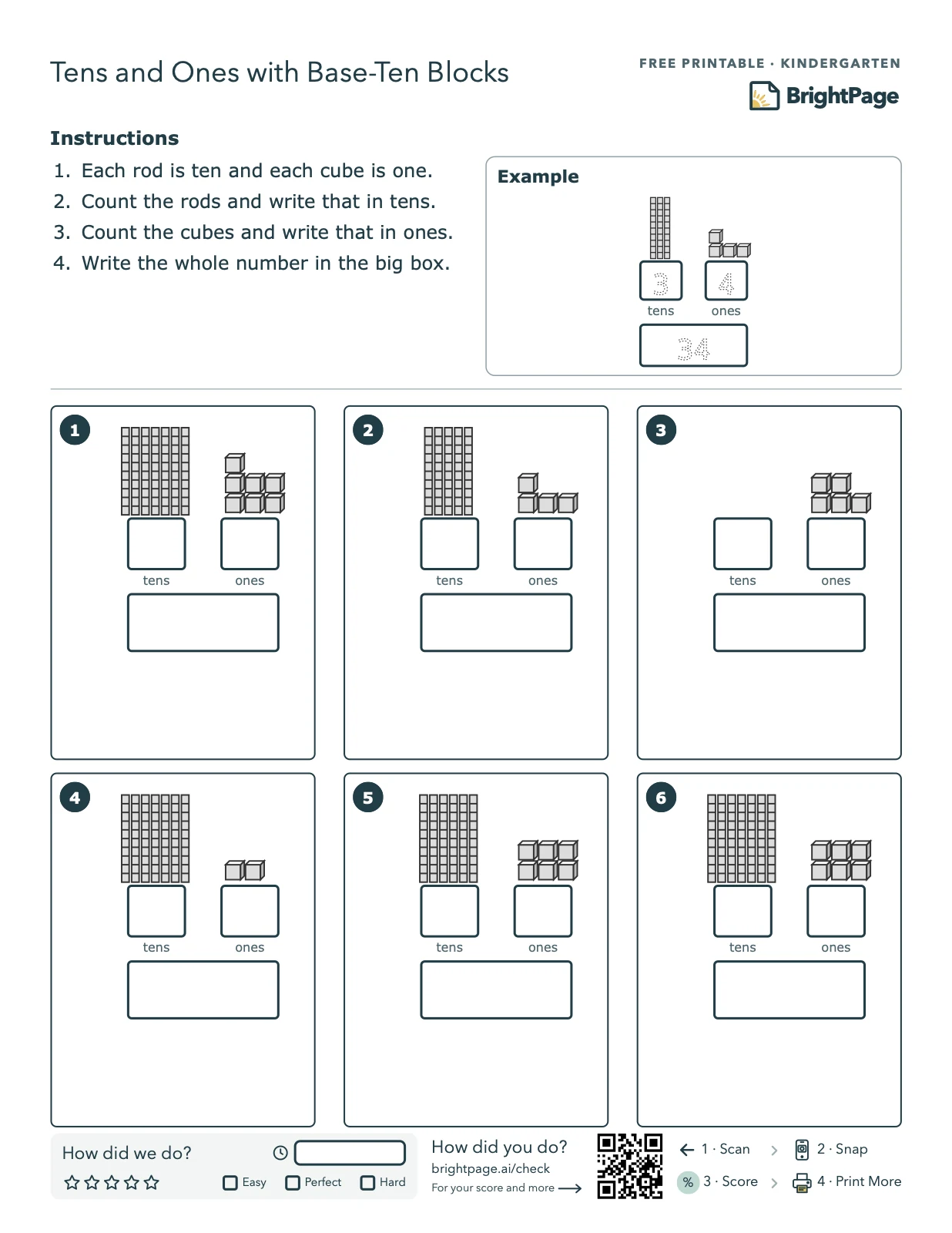
Tens and ones with blocks: 52 as 5 rods and 2 cubes (Tens and Ones with Base-Ten Blocks). Trade a rod for ten cubes and count: still 52.From the sheet: 3 rods and 4 cubes Answer: 3 tens, 4 ones, 34 13 − 3 = 1010 − 2 = 8
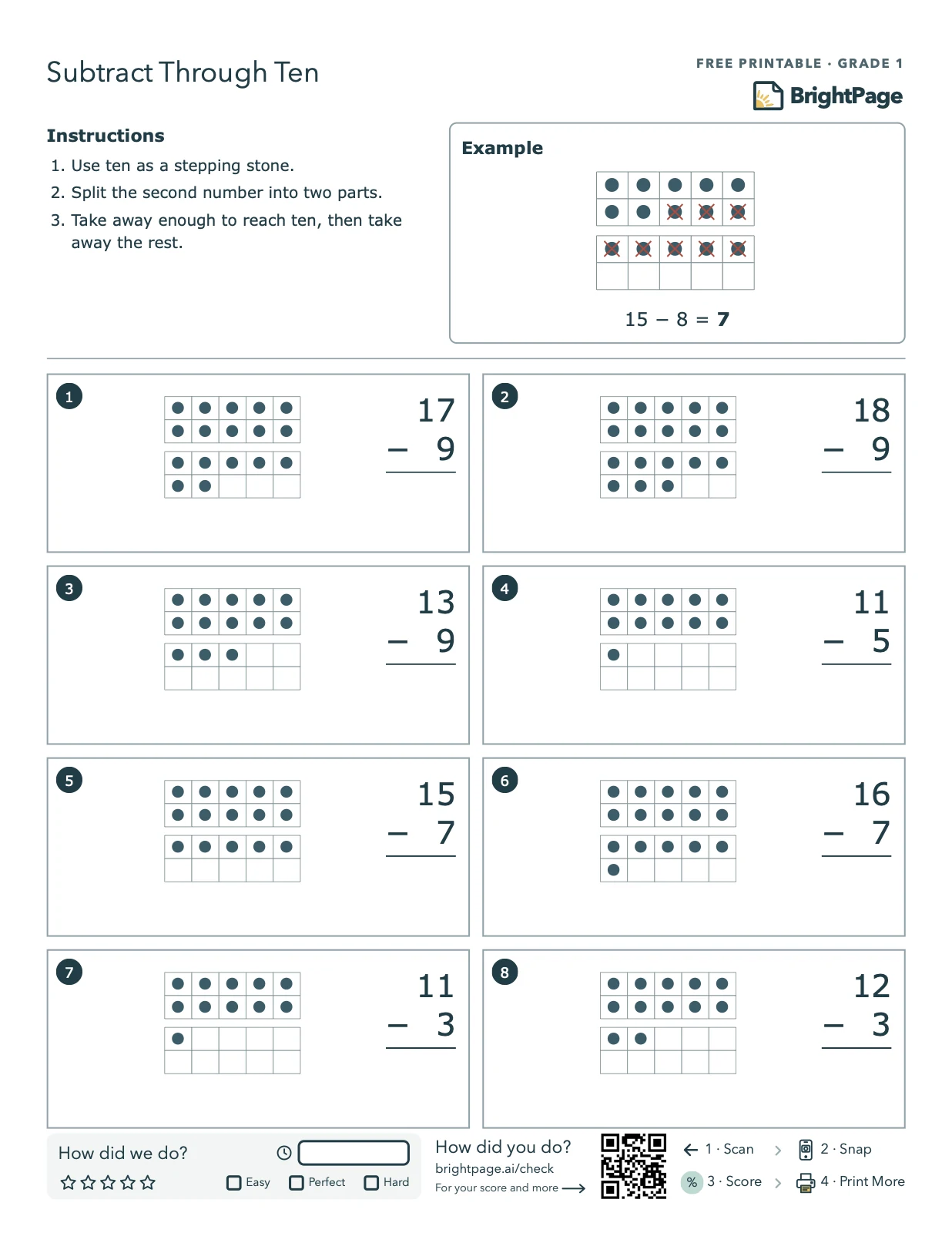
Subtracting through ten: 13 − 5 is the same as 13 − 3 (to get to 10), then 10 − 2 (Subtract Back Through Ten).From the sheet: 13 − 5 = ? Answer: 13 − 5 = 8 - 2432hundreds4tens3ones
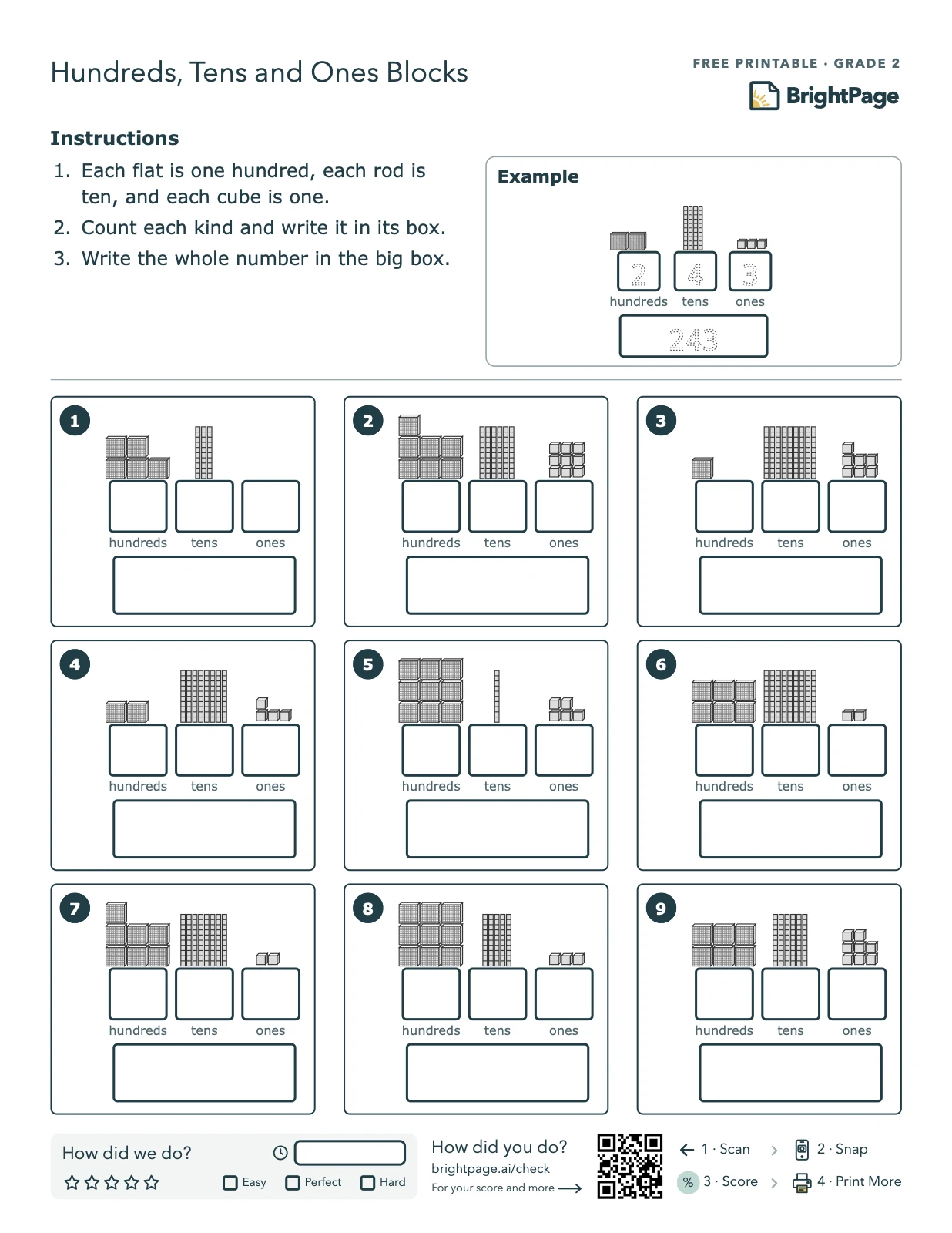
Hundreds, tens and ones: the same idea one place bigger (Hundreds, Tens and Ones Blocks).From the sheet: 2 flats, 4 rods and 3 cubes. What number is it? Answer: 243 - 41252−2725
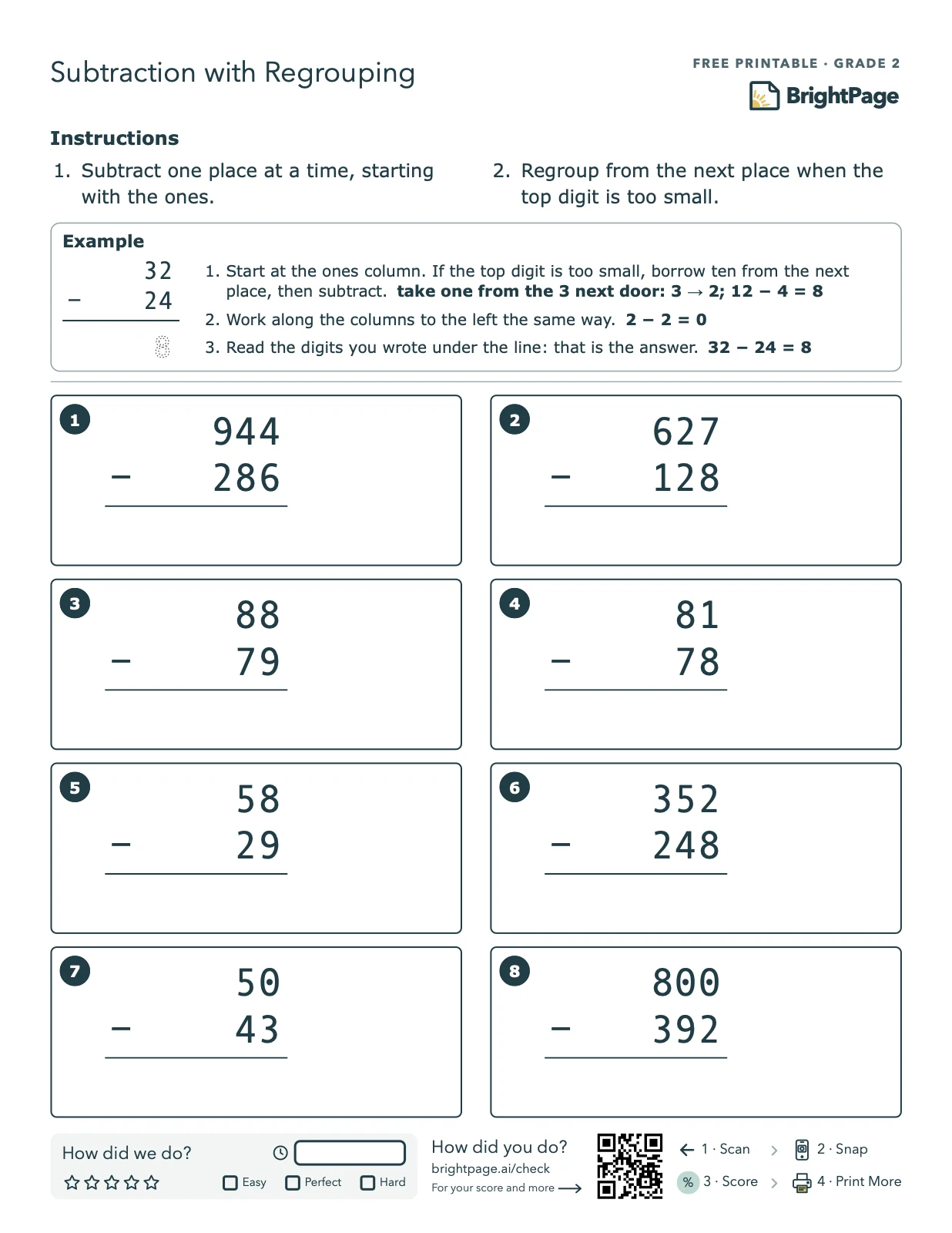
Two-digit subtraction with regrouping, written in columns (Subtraction with Regrouping).From the sheet: 52 − 27 = ? Answer: 52 − 27 = 25 - 691001570,015−32,40837,607
Bigger numbers, and borrowing across zeros (Subtracting Multi-Digit Numbers with Regrouping).From the sheet: 70,015 − 32,408 = ? Answer: 70,015 − 32,408 = 37,607
Three Habits That Prevent Most Mistakes
- Ask at every column: is the top digit smaller? If it is, regroup first, then subtract.
- Always top minus bottom. Saying it aloud helps it stick.
- Check by adding back. The answer plus the bottom number should give the top number: 25 + 27 = 52.
When a Page Goes Badly
If most of a page comes back wrong, it isn't your child's fault. The page jumped ahead too fast. Go back to tens and ones with blocks or drawings for a few days, then try the written steps again. Practice should feel mostly easy, with just one new thing at a time.
Which Grade Learns It?
Under the Common Core, which many states’ standards follow, second graders subtract within 100 using place value, and then within 1,000 using models or drawings, regrouping tens and hundreds (2.NBT.B.5 and 2.NBT.B.7). Fluency with the standard written method for multi-digit numbers comes in fourth grade (4.NBT.B.4). Check these against your school’s own standards.
How BrightPage Does It
Every new BrightPage math topic starts with a one-page lesson that shows each step in color, and every worksheet includes a worked example your child can look back at. If your child misses a multi-step problem, that topic comes back for review the next day. If the review goes poorly, BrightPage reteaches it the way it was first shown instead of handing over something harder. More on how review is spaced is on our learning-science page.
Free Printables for This
Print one, and your child works it in pencil. Each has a worked example on its page.
More Questions Parents Ask
Is regrouping the same as borrowing?
Yes. Regrouping, borrowing and trading all name the same step: taking one ten from the tens place and writing it as ten ones, so the ones can be subtracted. The number doesn't change: 52 is still 52 when it's written as 4 tens and 12 ones.
What grade learns subtraction with regrouping?
Usually second grade, first within 100 and then within 1,000, under the Common Core, which many states' standards follow. Fluency with the standard written method for bigger numbers is expected in fourth grade.
How do I explain borrowing across zeros?
When the next place is a zero, there is nothing to borrow there yet, so keep moving left until a digit can lend, then regroup back down. In 700 − 258, the 7 hundreds become 6 hundreds and 10 tens, then one of those tens becomes 10 ones: 6 hundreds, 9 tens and 10 ones, still 700. Now each column can be subtracted: 442.
Why does my child get it right one day and wrong the next?
Forgetting is normal, and a skill that was right on Tuesday can slip by Friday. Short reviews spaced over days and weeks catch it early. If the same mistake keeps coming back, step back to blocks or drawings for a few days.
Should my child use the standard method or another strategy?
Both have a place. Second graders often subtract with place-value strategies and drawings first, which show why regrouping works; the written column method is then a shorter way to record the same thing.
The Research
- Fyfe, E. R., McNeil, N. M., Son, J. Y., & Goldstone, R. L. (2014). Concreteness fading in mathematics and science instruction: A systematic review. Educational Psychology Review, 26(1). doi.org/10.1007/s10648-014-9249-3
- Common Core State Standards for Mathematics, Grade 2: Number and Operations in Base Ten (2.NBT.B.5, 2.NBT.B.7). thecorestandards.org/Math/Content/2/NBT/
- Common Core State Standards for Mathematics, Grade 4: Number and Operations in Base Ten (4.NBT.B.4). thecorestandards.org/Math/Content/4/NBT/