
How Do I Help My Child Practice Math Facts at Home?
The short answer
Practice a few facts a little every day, from memory, and bring back the ones your child misses. A minute or two on most days, built only from facts your child has already learned, does more than a long session once a week. Teach a strategy for each fact first (doubles, near doubles, making ten), then practice until the answer comes without counting.

By Caitlin Damani, Founder, BrightPage · Reviewed · 6 min read
Why Facts Are Worth a Few Minutes a Day
A child who has to work out 7 × 8 every time has little attention left for the word problem it sits inside. When a fact comes back without effort, that attention is free for the reasoning. Psychologists call this automaticity. The idea was first set out for reading (LaBerge and Samuels, 1974), and it holds just as well for the arithmetic inside a harder problem. In one brain-imaging study, how high school students’ brains handled single-digit problems like 6 + 7 predicted their scores on a standardized math test (Price, Mazzocco and Ansari, 2013).
Teach a Strategy Before You Ask for Speed
A fact a child can’t yet work out isn’t ready to be memorized. Start with the facts that unlock others, in roughly this order:
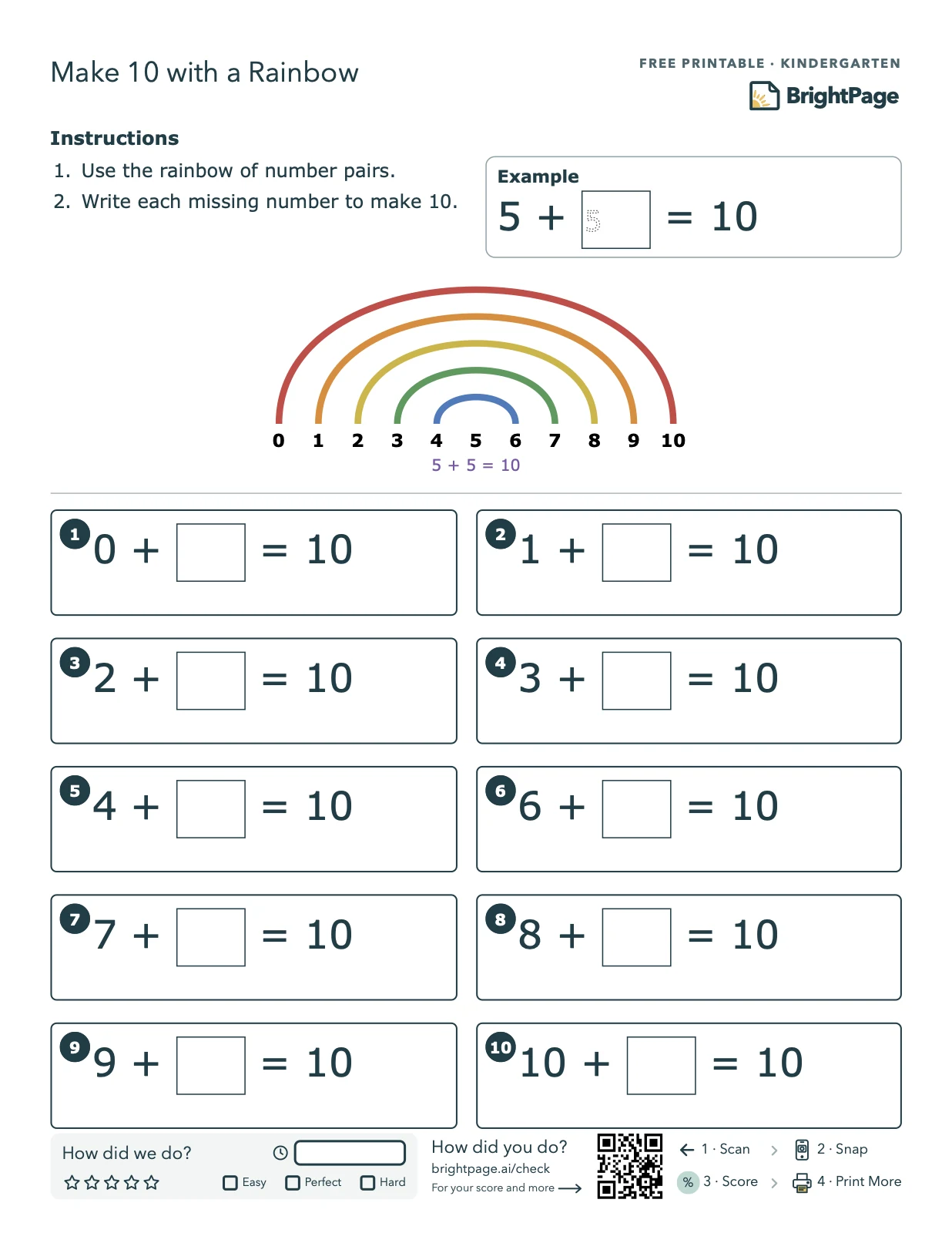
3 + 7 = 10
The pairs that make 10: 3 and 7, 4 and 6. Make 10 with a Rainbow shows all eleven.From the sheet: 3 + ? = 10 Answer: 3 + 7 = 10 6 + 6 = 12
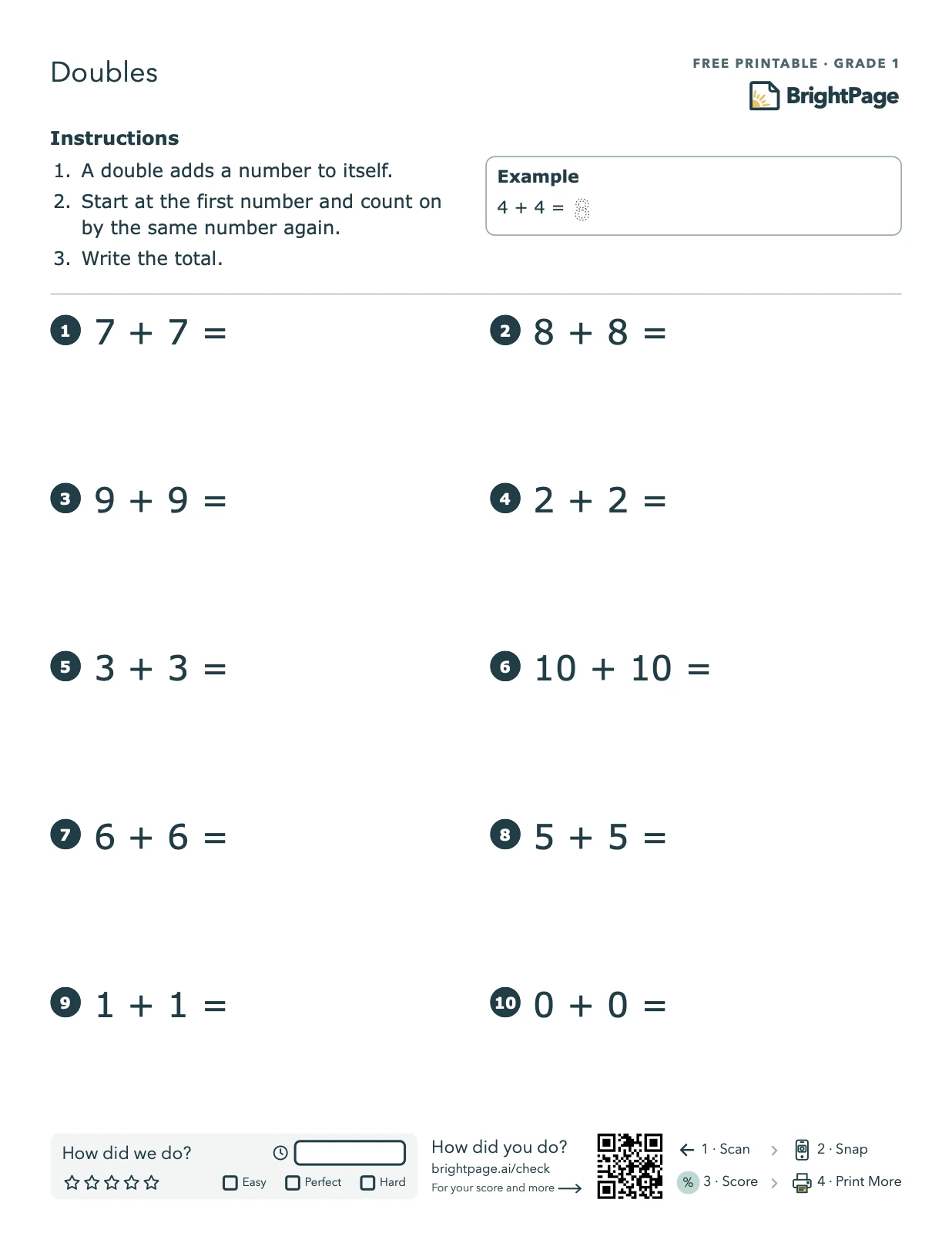
Doubles: 6 + 6, 8 + 8. Most children remember these first (Doubles).From the sheet: 6 + 6 Answer: 6 + 6 = 12 6 + 6 = 1212 + 1 = 13
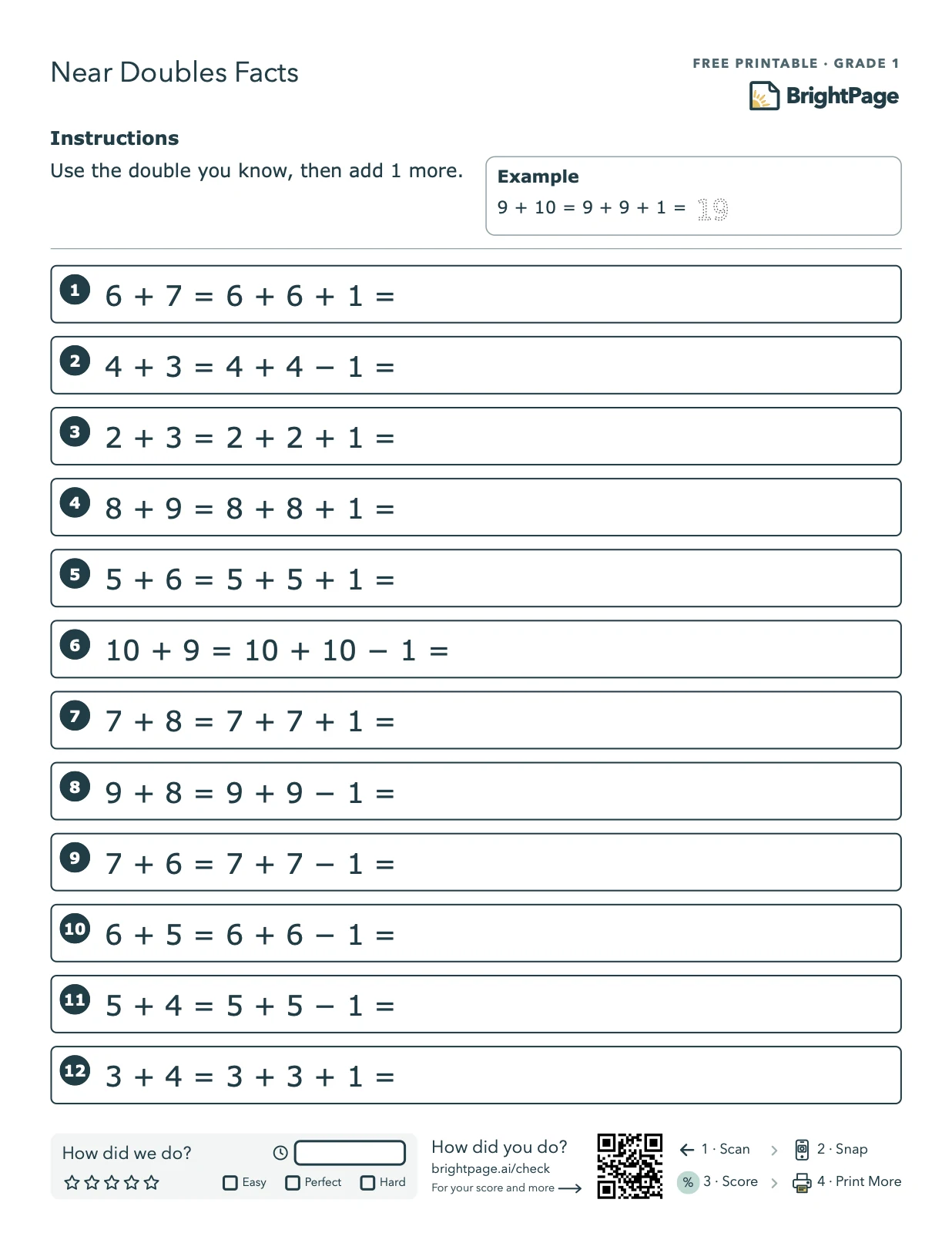
Near doubles: 6 + 7 is one more than 6 + 6 (Near Doubles Facts).From the sheet: 6 + 7 = ? Answer: 6 + 7 = 13 8 + 2 = 1010 + 3 = 13
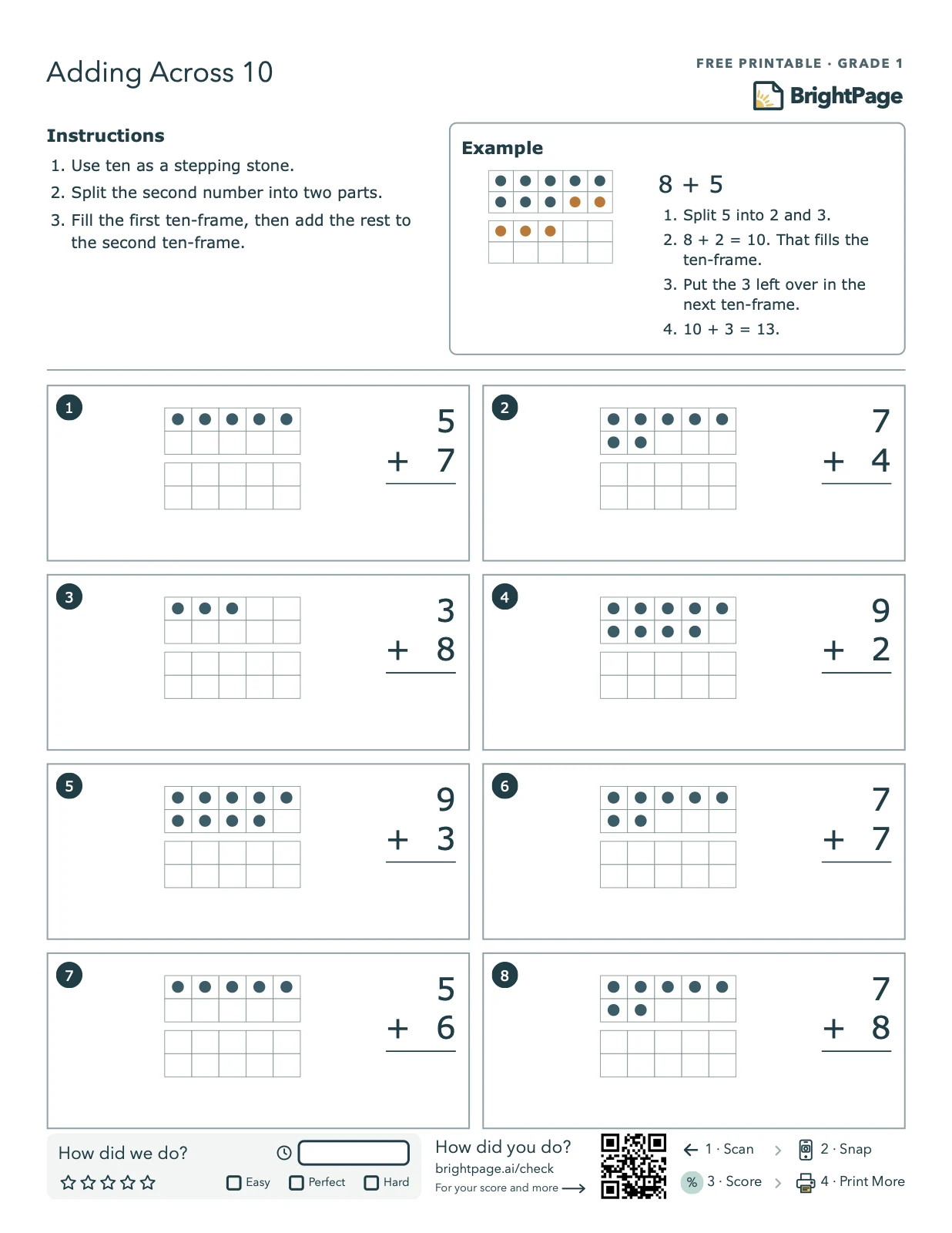
Making a ten: 8 + 5 is 8 + 2 + 3 (Adding Across 10).From the sheet: 8 + 5 = ? Answer: 8 + 5 = 13 13 − 3 = 1010 − 2 = 8
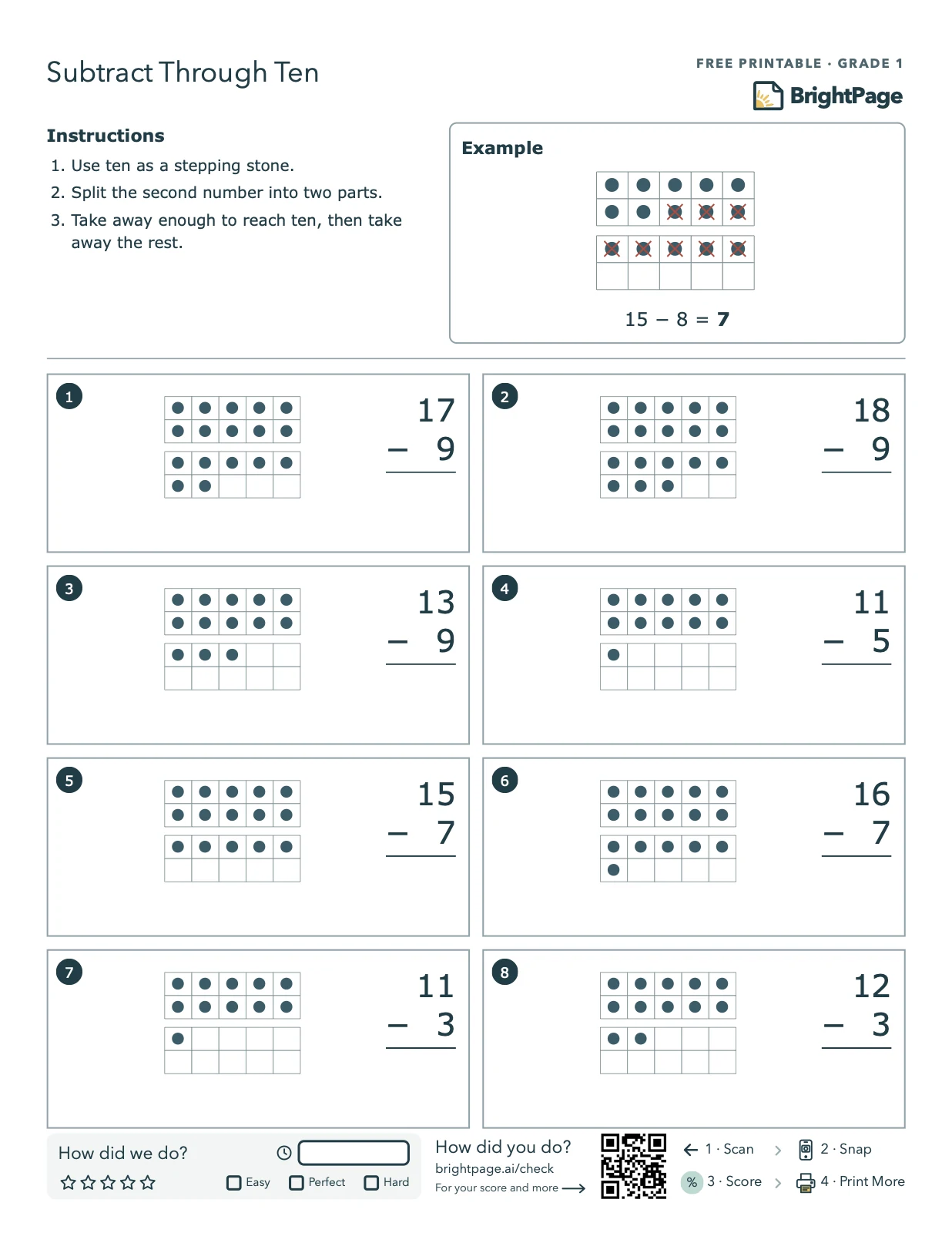
Subtracting back through ten: 13 − 5 is 13 − 3 − 2 (Subtract Back Through Ten).From the sheet: 13 − 5 = ? Answer: 13 − 5 = 8 7 × 4 = 28
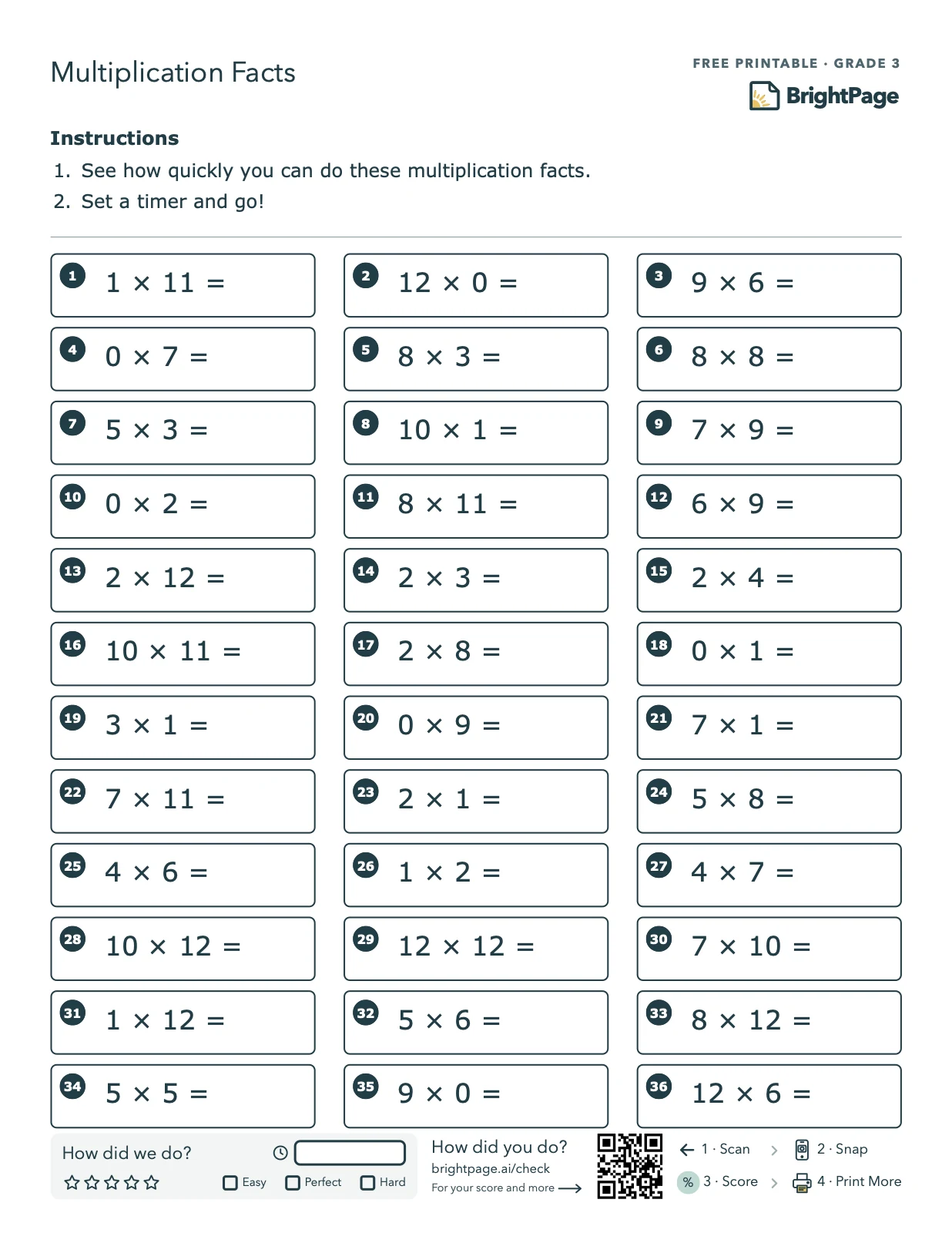
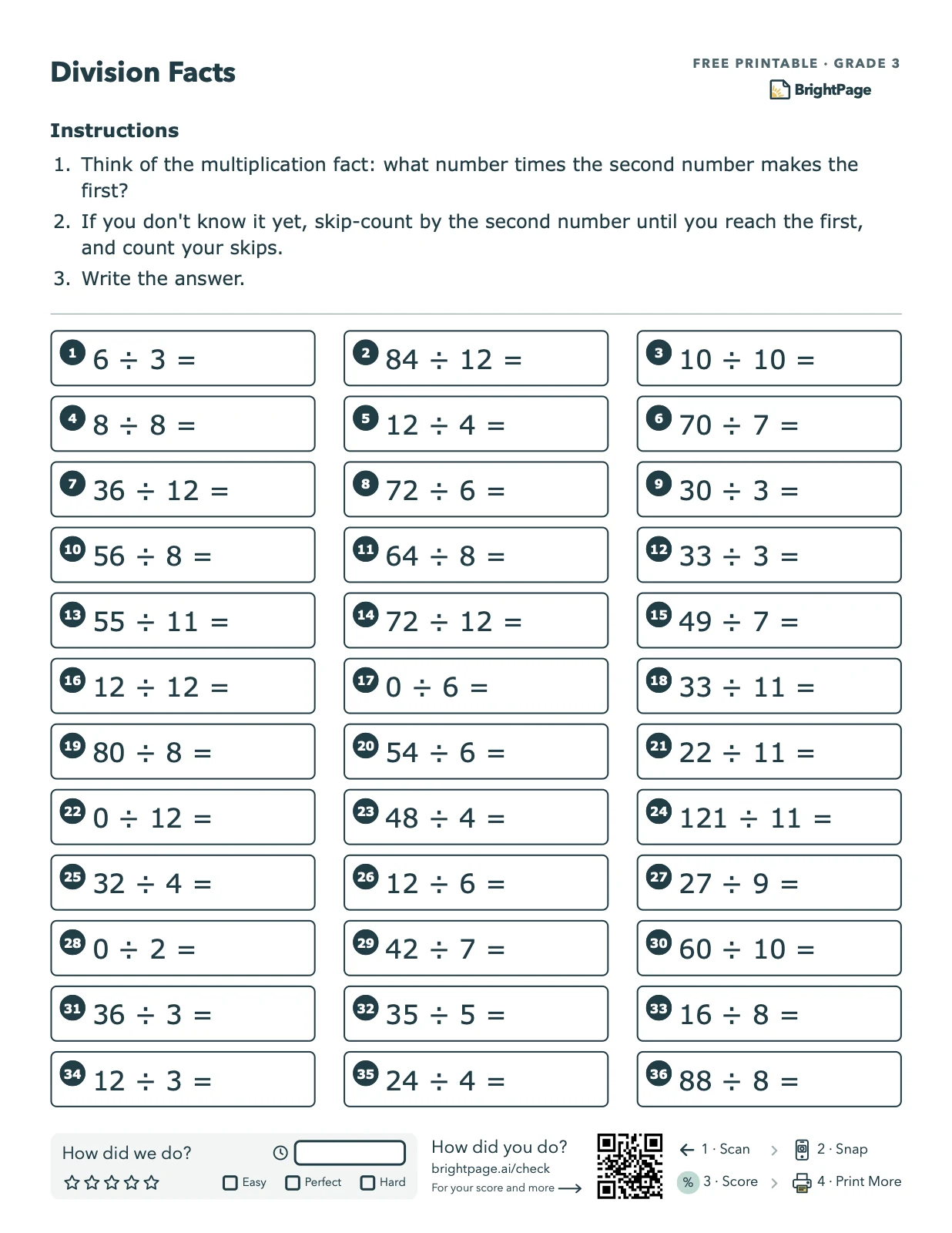
Multiplication, first by skip-counting (7 × 4 is 4, 8, 12 … 28), then from memory (Multiplication Facts). Division follows from the matching multiplication fact.From the sheet: 7 × 4 = Answer: 28
These are the strategies the first-grade standards name (Common Core 1.OA.C.6). Here is one worked through, from a free printable:
A worked example
6 + 7 = ?
- 6 and 7 are one apart.
- Use the double you know: 6 + 6 = 12.
- 7 is 1 more than 6, so the answer is 1 more than 12.
- 12 + 1 = 13.
Answer: 6 + 7 = 13
Practice From Memory, a Little Every Day
Two findings carry most of the weight. Answering from memory strengthens a fact more than looking at it again does (Roediger and Karpicke, 2006), so your child should write the answer before checking it, not read it off a chart. And practice spread over days outlasts the same practice crammed into one sitting (Cepeda and colleagues, 2006). A facts page of a minute or two on most days does more than a long session on Saturday.
A routine that fits on the kitchen table:
- Pick facts your child has already learned, with a strategy for each.
- Mix them up, so an answer can’t come from the pattern down a column.
- Answer in pencil, from memory. If a fact still needs counting, that’s fine: circle it.
- Check together, and write the missed and circled facts on a short list.
- Put those facts on the next page, and keep them coming until they’ve been right several times. Then let them come back less often.
Use the Timer Lightly
A timer can turn a page into a game: beat yesterday’s time. It shouldn’t decide whether a child is ready to move on. Accuracy comes first, and speed follows practice. If the timer brings a frown instead of a grin (or a sudden, urgent need for a snack), put it away for a while.
Which Facts by Which Grade?
Under the Common Core, which many states’ standards follow, a first grader adds and subtracts within 10 fluently (1.OA.C.6). By the end of second grade, a child knows all sums of two one-digit numbers from memory (2.OA.B.2), and by the end of third grade, all products of two one-digit numbers (3.OA.C.7). Check these against your school’s own standards.
How BrightPage Does It
Each day of math in BrightPage includes a facts drill of under three minutes, built only from facts your child has been taught. A fact they miss is asked again on the next facts sheet and keeps appearing until it has been answered correctly several times. Speed shapes how the drill is practiced but never decides whether your child moves on. Your child works it in pencil, you photograph the page, and AI scores it. The rest of the day’s minutes, which you set, go to review and the next new topic. The research behind each step is on our learning-science page.
Free Printables for This
Print one, and your child works it in pencil. Each has a worked example on its page.
More Questions Parents Ask
How long should math fact practice take each day?
A few minutes is enough. Practice spread over many days lasts longer than the same practice crammed into one sitting, so a minute or two of facts on most days, inside whatever time you set aside for practice, does more than an hour on the weekend.
Should I use a timer for math facts?
Lightly, if at all. A timer can turn a page into a game of beating yesterday's time, but accuracy comes first and speed follows practice. If the timer brings a frown instead of a grin, put it away.
What order should my child learn addition facts in?
Start with the pairs that make 10 and the doubles, then near doubles (6 + 7 is one more than 6 + 6), then making a ten (8 + 5 is 8 + 2 + 3). Each strategy turns facts a child doesn't know yet into facts they do.
When should my child know multiplication facts by heart?
The Common Core, which many states' standards follow, expects every product of two one-digit numbers from memory by the end of grade 3. Check your school's own standards, since they can differ.
Are flash cards or worksheets better for math facts?
Either works when your child answers from memory before checking. A worksheet done in pencil also leaves a record of exactly which facts were missed, so the next day's practice can bring those back.
The Research
- LaBerge, D., & Samuels, S. J. (1974). Toward a theory of automatic information processing in reading. Cognitive Psychology, 6(2). doi.org/10.1016/0010-0285(74)90015-2
- Price, G. R., Mazzocco, M. M. M., & Ansari, D. (2013). Why mental arithmetic counts: Brain activation during single digit arithmetic predicts high school math scores. Journal of Neuroscience, 33(1). doi.org/10.1523/JNEUROSCI.2936-12.2013
- Roediger, H. L., & Karpicke, J. D. (2006). Test-enhanced learning: Taking memory tests improves long-term retention. Psychological Science, 17(3). doi.org/10.1111/j.1467-9280.2006.01693.x
- Cepeda, N. J., et al. (2006). Distributed practice in verbal recall tasks: A review and quantitative synthesis. Psychological Bulletin, 132(3). doi.org/10.1037/0033-2909.132.3.354
- Common Core State Standards for Mathematics, Grade 1: Operations and Algebraic Thinking (1.OA.C.6). thecorestandards.org/Math/Content/1/OA/
- Common Core State Standards for Mathematics, Grade 2: Operations and Algebraic Thinking (2.OA.B.2). thecorestandards.org/Math/Content/2/OA/
- Common Core State Standards for Mathematics, Grade 3: Operations and Algebraic Thinking (3.OA.C.7). thecorestandards.org/Math/Content/3/OA/