
How Do I Teach My Child to Blend CVC Words?
The short answer
Have your child say each letter's sound, not its name, then push the sounds together with no gaps until they turn into a word: /sss/ /aaa/ /t/, sat. Start with words that begin with a sound you can stretch, like s, m or f, and keep quick sounds like /t/ crisp, with no “uh” on the end.

By Caitlin Damani, Founder, BrightPage · Reviewed · 5 min read
What CVC Words Are, and What Blending Means
CVC words have three letters: a consonant, a short vowel and a consonant, as in sat, pig and hop. They are the first words most children read by sounding out. Blending is the step that turns knowing letter sounds into reading: saying the sounds one after another and pushing them together until they become a word.
Teaching the links between letters and sounds directly, in a planned order, is the most reliable way into reading that researchers have found (Castles, Rastle and Nation, 2018). Blending is where that teaching starts to pay off: the first time a child reads a word nobody told them.
Start With Sounds Your Child Can Hold
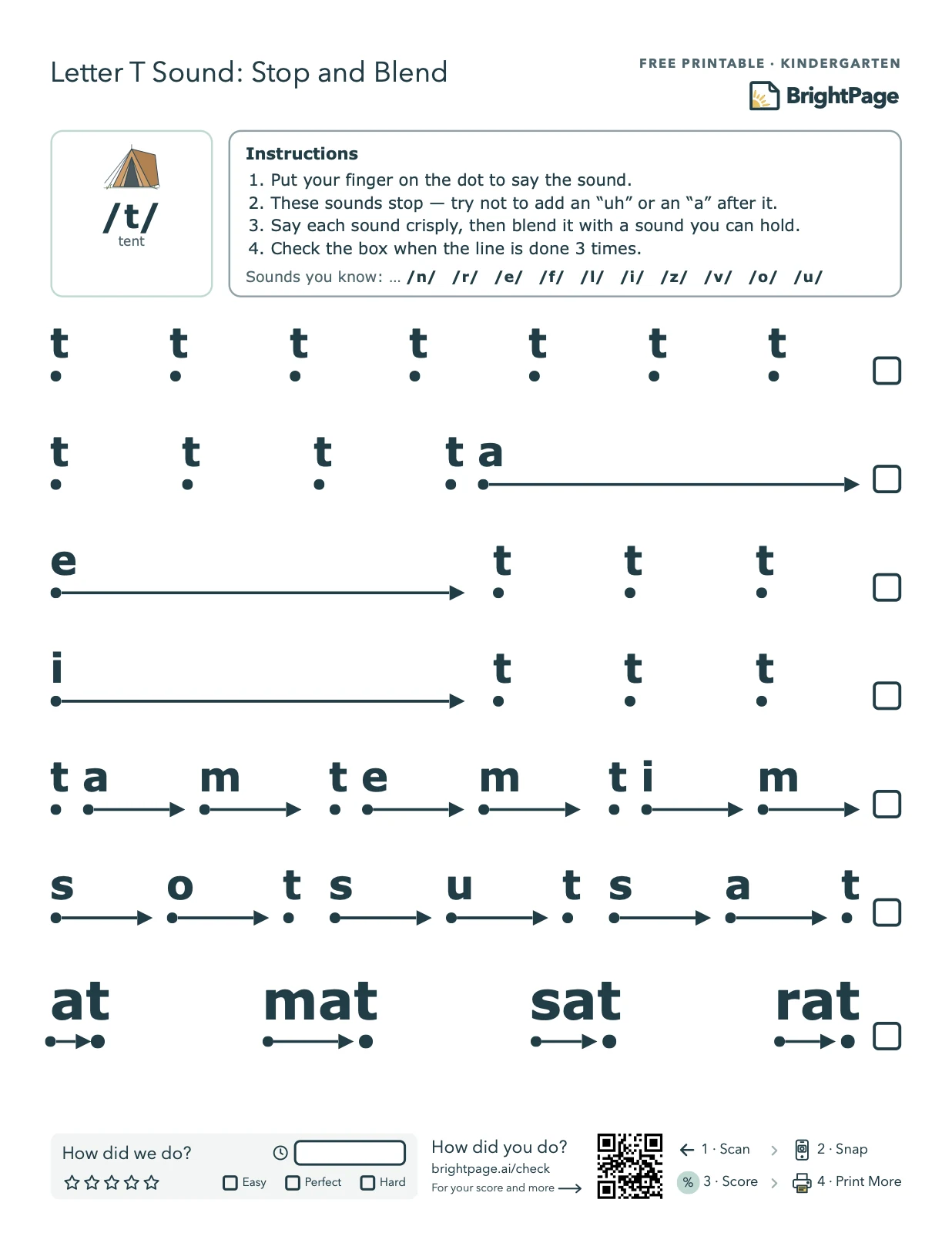
Some sounds can be stretched for as long as a breath lasts: /sss/, /mmm/, /fff/, /lll/, /nnn/, /rrr/ and the short vowels. Others come out in one quick burst and stop: /t/, /p/, /b/, /d/, /k/, /g/. Held sounds run into each other with no gap, so they blend easily. A stop sound held too long grows an “uh” on the end, and “suh-a-tuh” never turns into sat.
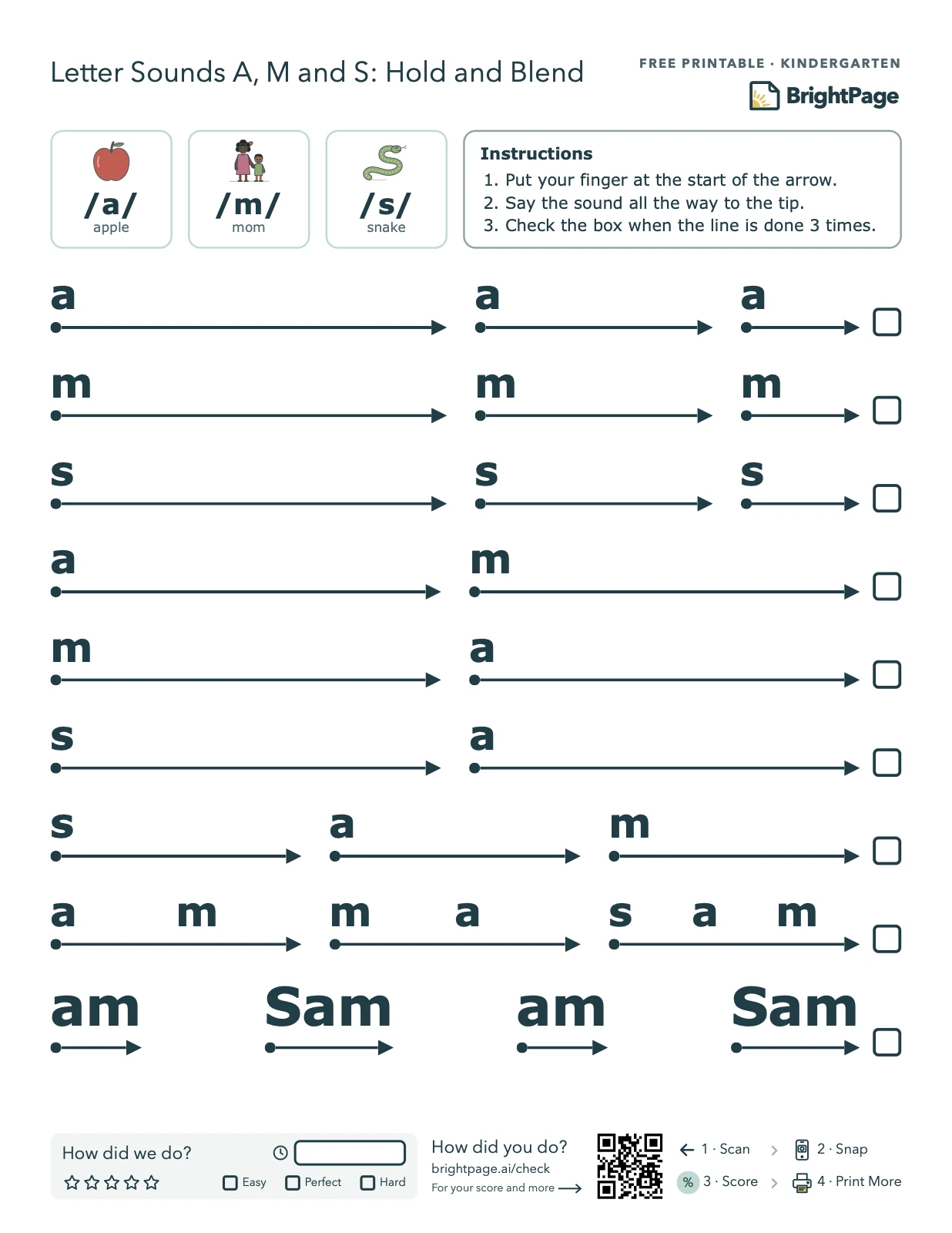
So begin with a few held sounds. Our kindergarten phonics starts with /a/, /m/ and /s/ on day one, because they are the fewest sounds that make words a child can read the same day: am and Sam (Letter Sounds A, M and S: Hold and Blend). Stop sounds come later and are said once, crisp, then stopped. Whispering helps: a whispered /t/ is just the tap and the air (Letter T Sound: Stop and Blend).
The Steps, at the Kitchen Table
- Put a finger under the first letter and say its sound.
- Slide the finger along, saying each sound with no break: “sssaaat.”
- Say it again faster, then at talking speed: sat.
- Use it in a sentence, so the word lands as a word and not just a sound.
- Write it. Writing the word ties the sounds to the letters one more time.
A worked example
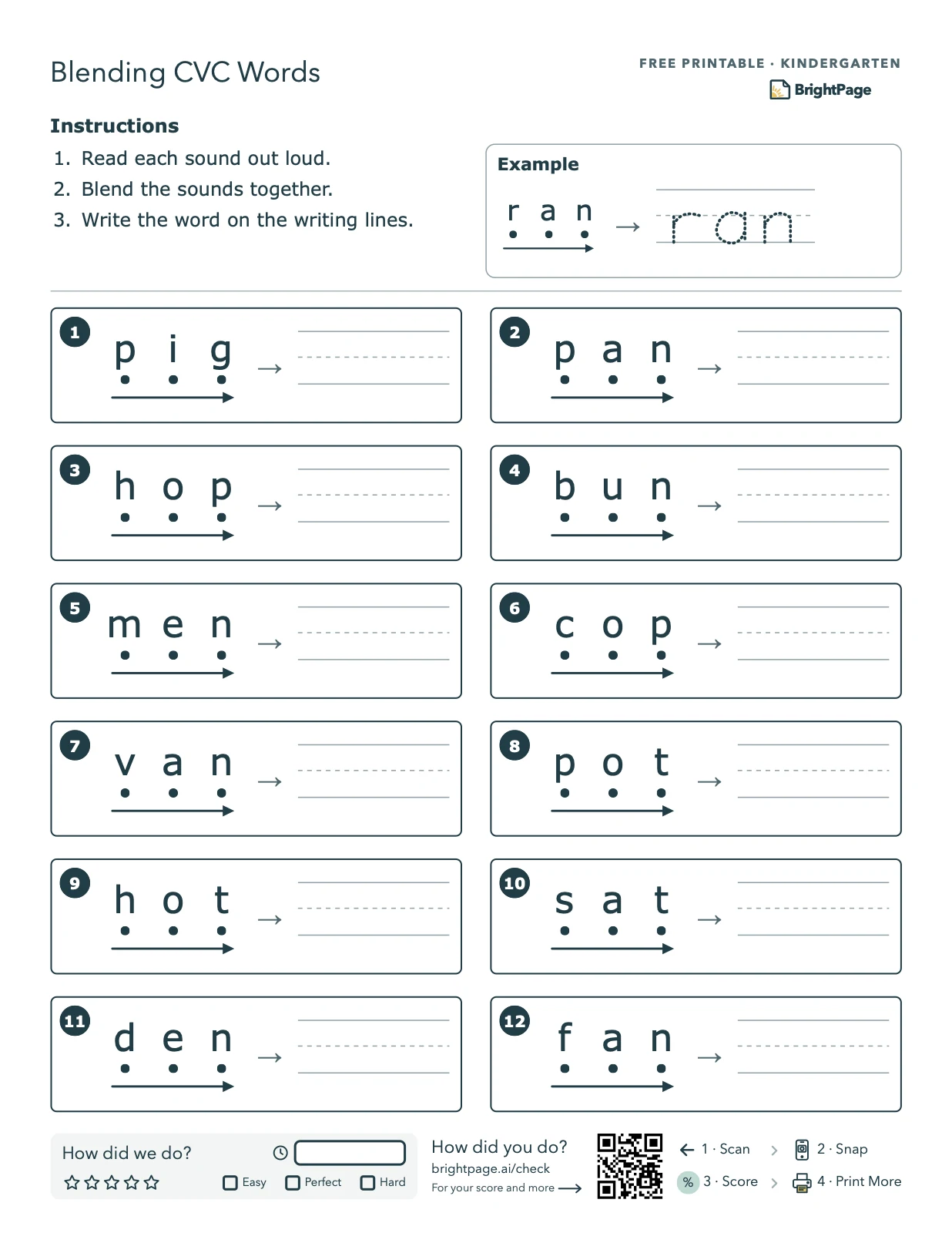
- Say each sound on its own: /s/ /a/ /t/ (that's what the dots underneath represent).
- Say them again, stretched and joined with no gaps: "sssaaat" (that's what the arrow represents).
- Say it fast. The word is sat.
- Write sat on the lines.
Answer: sat
An Order That Keeps It Easy
Every page should feel easy. If blending is a struggle, step back a level rather than push on; it means the words started too far ahead, not that your child can’t do it.
- Two sounds, both held: am.
- Three sounds, starting with a held one: sat, man, fan, mop.
- Words that start with a stop sound: tap, dog, bat. The stop goes straight into the vowel: /ta/, never “tuh-a.”
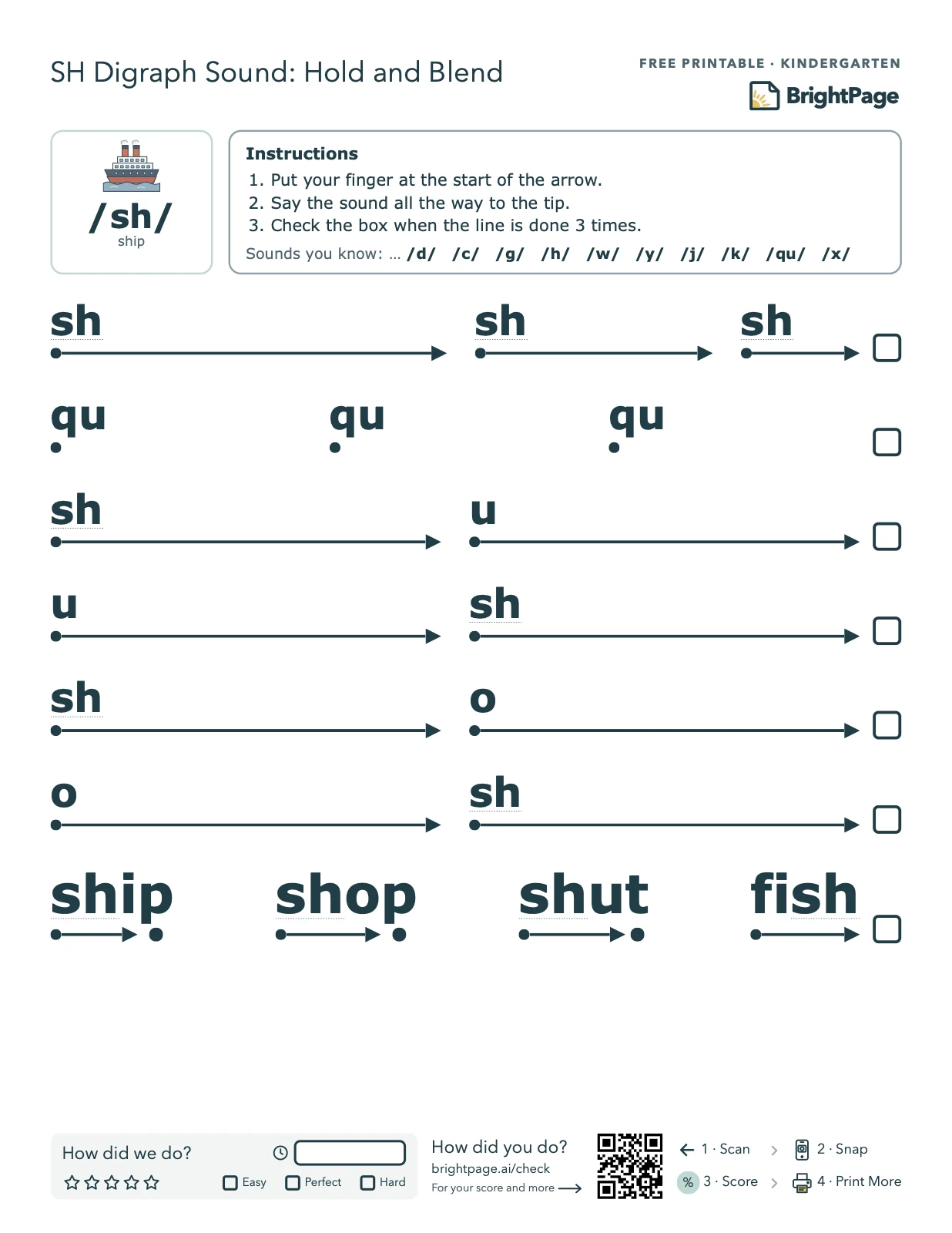
- Two letters, one sound: sh, ch, th, as in ship, chop and that (SH Digraph Sound: Hold and Blend).
- Blends, where two consonants keep their own sounds: cl in clock, tr in truck.
A Few Minutes a Day
Blending grows with short, frequent practice: a handful of words read aloud and written, on most days. In BrightPage, kindergarten phonics runs 100 days, with one new sound a day after the first three, and every third sound is a vowel, since vowels are what turn letters into words. Each sheet holds the new sound on its own, joins it to sounds from earlier days, and ends on real words your child can read. How we chose that order is on our learning-science page.
Free Printables for This
Print one, and your child works it in pencil. Each has a worked example on its page.
More Questions Parents Ask
What does CVC stand for?
Consonant, vowel, consonant: three-letter words with a short vowel in the middle, such as sat, pig, hop and bed. They are the first words most children read by sounding out.
Which CVC words should we start with?
Words that begin with a sound you can stretch, such as /s/, /m/ or /f/, with a short a in the middle: sat, mat, Sam, man, fan. Held sounds run into each other with no gap, which makes the first blends easier.
My child can say each sound but can't put them together. What helps?
Hold each sound longer and leave no gap between them (“sssaaat”), then say it faster. If the word still won't come, go back to two-sound words like am, or to words that start with a stretchy sound. That means the words were a step too far ahead, not that your child can't do it.
Why does my child say “tuh” for t?
/t/ is a quick sound that can't be stretched, so children add “uh” to make it last long enough to hear. Whisper it: a whispered /t/ is just the tap and the air. Then say it straight into the vowel: /ta/.
What comes after CVC words?
Digraphs, where two letters make one sound (sh in ship, ch in chop), and blends, where two consonants keep their own sounds (cl in clock, tr in truck). Silent e words like cake come after those.
The Research
- Castles, A., Rastle, K., & Nation, K. (2018). Ending the reading wars: Reading acquisition from novice to expert. Psychological Science in the Public Interest, 19(1). doi.org/10.1177/1529100618772271