
What Is Spaced Practice, and How Do I Use It at Home?
The short answer
Spaced practice means reviewing something a little at a time over days and weeks, instead of all at once. The same amount of practice, spread out, is remembered far longer than practice crammed into one sitting, and it works best when your child recalls the answer from memory before checking. Start with short gaps, a day or a few days, and let them grow each time the answer comes back right; when it doesn’t, shorten the gap again.

By Caitlin Damani, Founder, BrightPage · Reviewed · 6 min read
What Spaced Practice Is
Spaced practice is reviewing something a little at a time, with gaps of days or weeks in between, rather than all at once. Ten minutes on four different days beats forty minutes on one, even though the total is the same. Practice spread out is remembered far longer than the same practice crammed together (Cepeda and colleagues, 2006), a finding repeated in hundreds of studies, for memory, for problem solving and for using what was learned in new situations (Kang, 2016). A major review of study techniques rated it one of the two most useful a learner can use (Dunlosky and colleagues, 2013).
Cramming gets you through Friday’s test. The same practice spread across the week is what’s still there in June.
Why a Little Forgetting Helps
Spacing works partly because it lets a child forget a little. When 7 × 8 comes back after a few days, your child has to dig for it, and that effort of recalling is what makes it stick. Recalling an answer from memory strengthens it more than looking at it again does (Roediger and Karpicke, 2006), and adding that kind of recall to spaced practice adds to the benefit (Kang, 2016).
So a review should ask your child to recall the answer, out loud or on paper, rather than show it again. Recognizing something is not the same as recalling it. A child who flips through flash cards of tricky words like would, could and should may read them easily at longer and longer gaps and still misspell them in their own writing, because reading a card never asked them to produce the spelling.
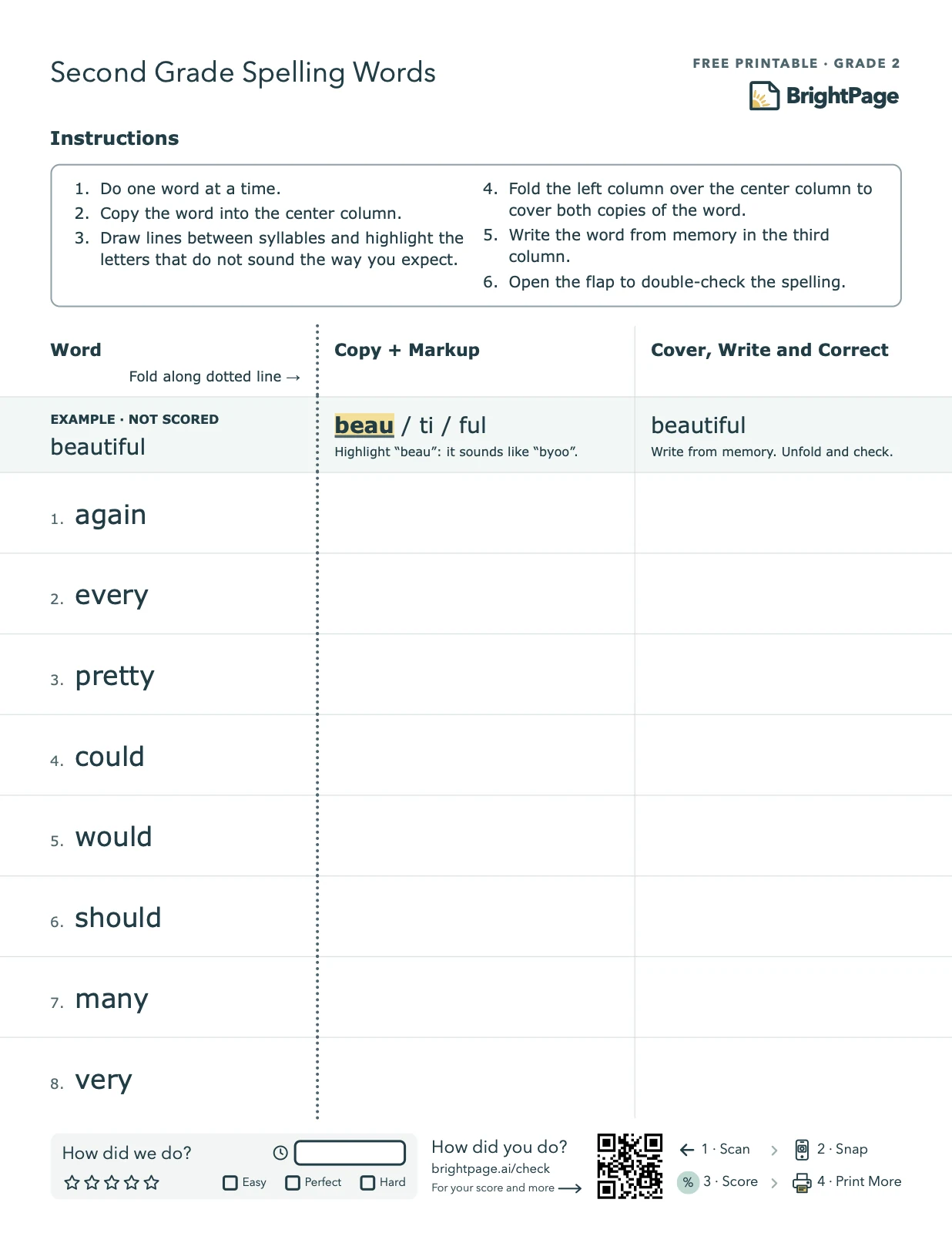
How the question is asked matters too. A child who spells could correctly when you say it on its own may still write “cud” in the middle of a sentence, when their mind is on what they want to say. Once a word is right on its own, ask for it in a sentence as well, the way it will really be used. On paper, that means covering the word, writing it from memory, then checking (Second Grade Spelling Words).
Gaps That Grow
The right gap depends on how well something is known. A fact your child just learned needs to come back soon, in a day or a few days, before it slips away entirely. Each time it comes back right, the next gap can be longer: a week, two weeks, a month. When it’s missed, the gap shrinks again. The longer something needs to last, the longer the best gap tends to be (Cepeda and colleagues, 2006).
Mix It Up
A review page works harder when it mixes kinds of problems instead of repeating one. On a page of nothing but subtraction, a child never has to decide what to do. Mix in addition and a few times facts, and every problem asks which method fits, which is the decision a test or a real problem asks for. Students given shuffled practice did markedly better on a later test than students who practiced one kind at a time (Rohrer and Taylor, 2007).
A Spaced Routine for the Kitchen Table
You don’t need software for this. Three envelopes and a few minutes a day will do:
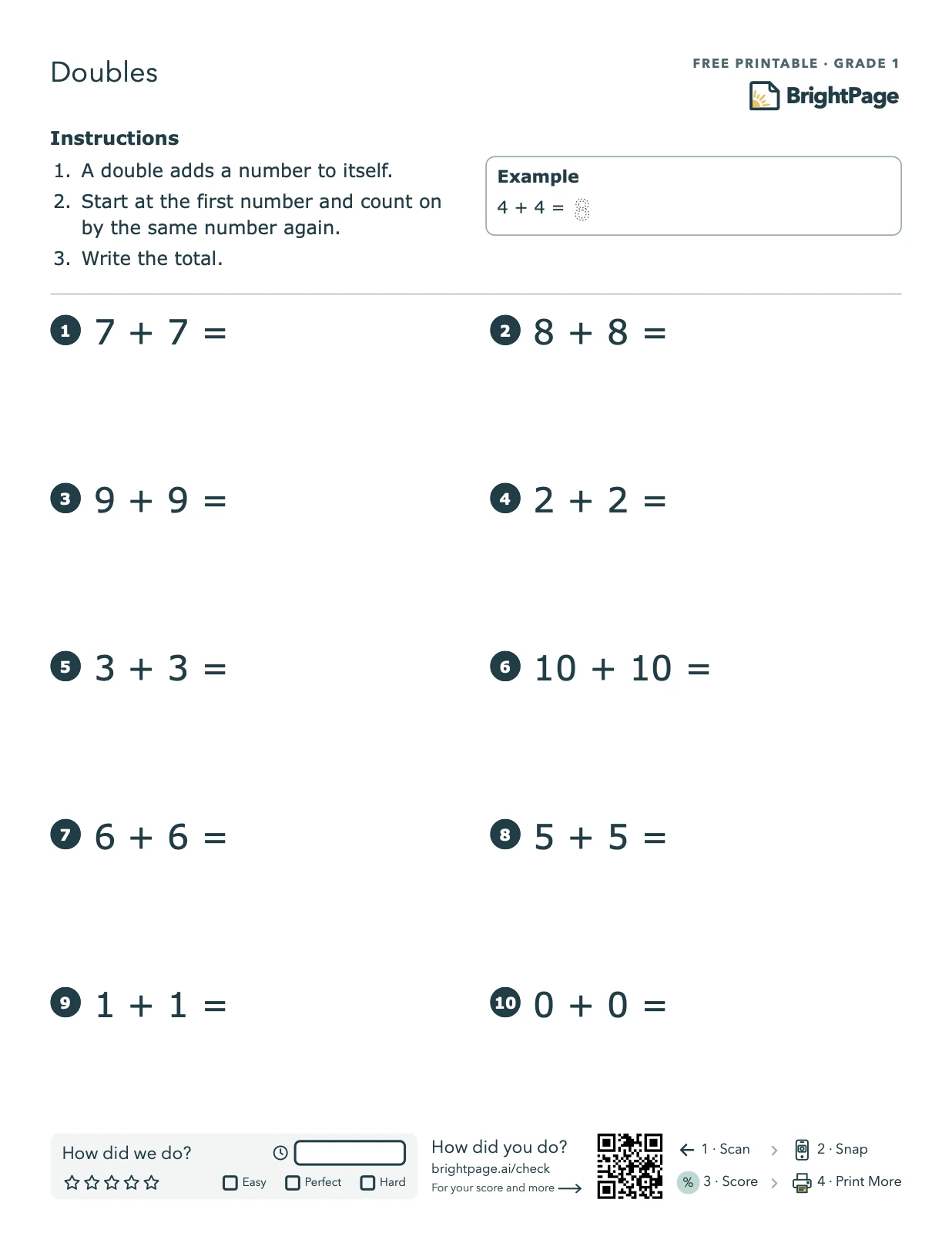
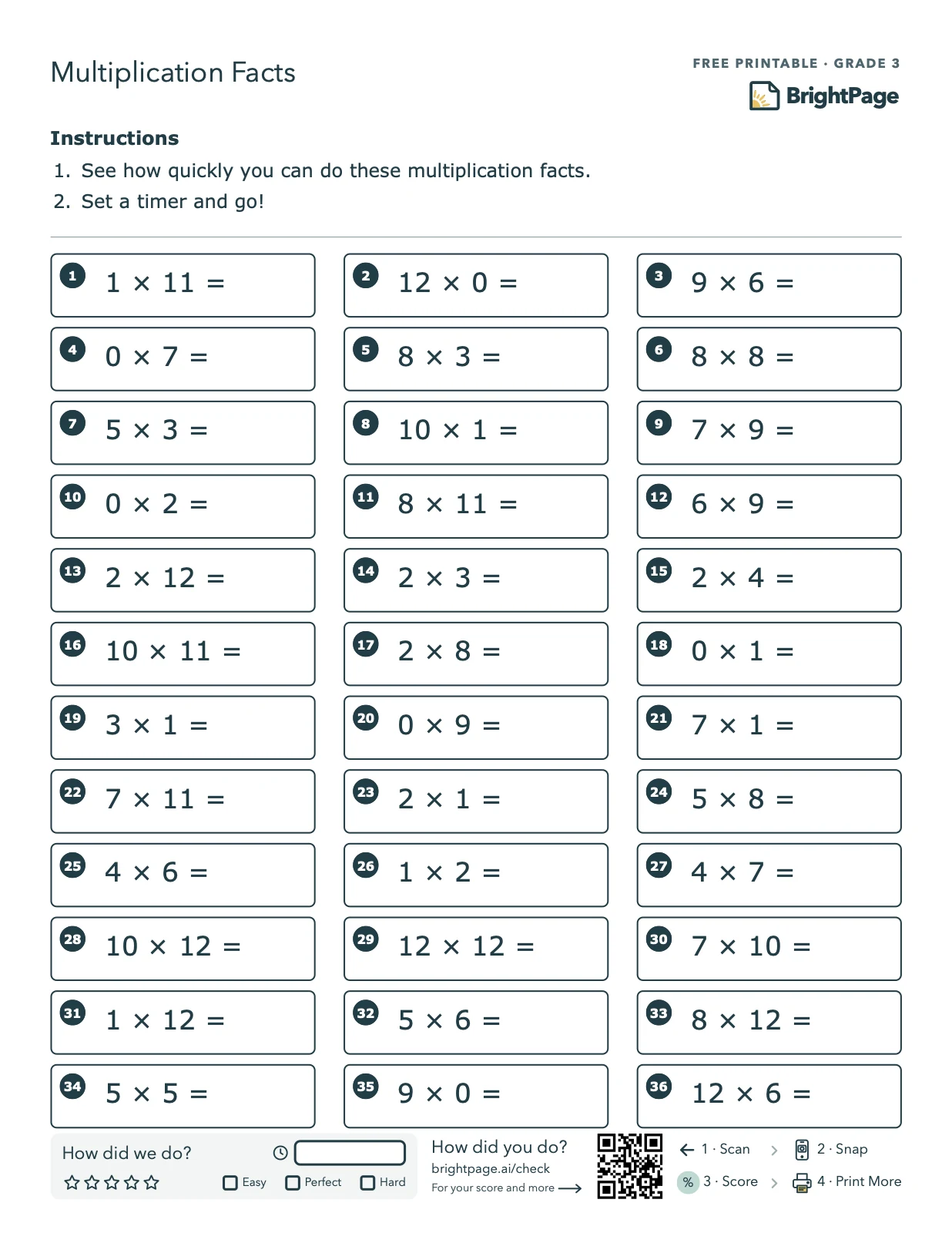
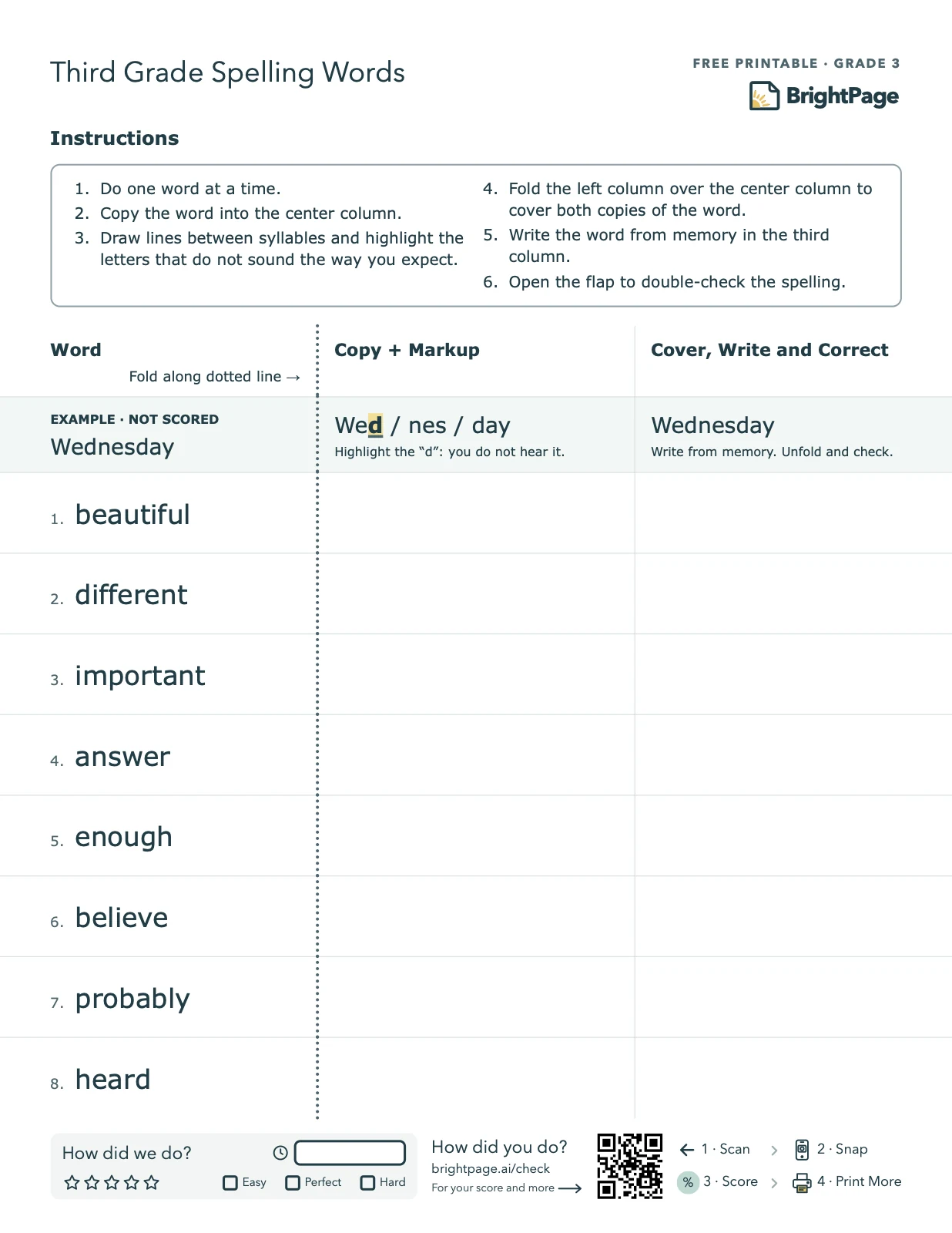
- Write the facts or words your child is learning on cards: math facts (Doubles, Multiplication Facts) or spelling words (Third Grade Spelling Words).
- Label three envelopes: Every day, Every few days and Every week. New cards start in Every day.
- Each day, go through Every day, plus the other envelopes when their turn comes. Your child answers before turning the card over.
- A card answered right moves one envelope along. A card missed goes back to Every day.
- Keep sessions short: a few minutes, stopped before attention runs out (or before the snack request wins).
A worked example
One new card: 7 × 8
- Monday: the card starts in Every day. Your child says 56 before turning it over, so it moves to Every few days.
- Thursday: that envelope’s turn. 56 again, so the card moves to Every week.
- The next Thursday: your child says 54. The card goes back to Every day.
- Friday: 56. The card moves to Every few days and starts the climb again.
Result: four short recalls in under two weeks, each from memory, and the one miss brought the card straight back to daily practice.
What Gets in the Way
- Reviewing only before a test. It feels efficient, and it fades. A little review every week keeps more.
- Reading instead of recalling. Looking over a list of answers feels like review but asks nothing. Cover the answer first.
- Gaps too long too soon. If almost everything is forgotten at each review, the gaps are too wide for now. Shorten them. It means the schedule ran ahead of your child, not that your child can’t learn it.
- Reviewing only what’s easy. The cards that keep coming back are the ones doing the most good.
How BrightPage Does It
BrightPage keeps the schedule for you. A missed math fact is asked again on the next facts sheet and keeps appearing until it has been answered correctly several times. A topic still being learned is reviewed three days after it was last practiced. Once it’s mastered, it is reviewed after 3 days, and each review that comes back with no more than one wrong answer stretches the wait to 7 days, then 14, then 30, and then once a month. A review with two or more wrong answers brings it back the next day, and the gaps build up again. From first grade, a missed spelling rule returns every other day, and a missed word is reviewed until it has been spelled correctly three times. Kindergarten has no separate review page: its lessons build on each other, so each day already practices what came before.
Your child works each page in pencil, you photograph it, and AI scores it, so the schedule follows what your child actually wrote. A missed day costs nothing: the next sheets follow the finished ones, not the calendar. The research behind each step is on our learning-science page.
Free Printables for This
BrightPage specializes in spaced repetition and learning through mastery. Find out how it works, or get started with a free trial. Or start with one of these free sheets:
More Questions Parents Ask
What is spaced practice?
Practicing something a little at a time, with gaps of days or weeks between, instead of all in one sitting. It is also called distributed practice or spaced repetition. The same total practice, spread out, is remembered far longer.
How far apart should practice sessions be?
Start short and let the gaps grow. Something new comes back the next day or within a few days; once it comes back right, wait a week, then two, then a month. If it's missed, go back to a short gap. The longer something needs to last, the longer the gaps can be.
Is spaced practice the same as spaced repetition?
Near enough. Spaced repetition usually means flash cards or an app that schedules each card, while spaced practice is the wider idea: any review spread over time, including a worksheet with a few earlier problems on it.
Doesn't cramming work?
For tomorrow's test, it can. But what is crammed fades quickly, while the same practice spread across the week is what's still there months later. Cramming feels faster because everything is fresh; spacing feels harder because some of it has been forgotten, and that effort of remembering is what makes it last.
Does spaced practice work for young children?
The research reviews find the benefit for learners of different ages, children included, and for many kinds of material, from spelling and math facts to problem solving. For young children, keep each session short and the gaps short at first.
The Research
- Cepeda, N. J., et al. (2006). Distributed practice in verbal recall tasks: A review and quantitative synthesis. Psychological Bulletin, 132(3). doi.org/10.1037/0033-2909.132.3.354
- Kang, S. H. K. (2016). Spaced repetition promotes efficient and effective learning: Policy implications for instruction. Policy Insights from the Behavioral and Brain Sciences, 3(1). doi.org/10.1177/2372732215624708
- Dunlosky, J., et al. (2013). Improving students’ learning with effective learning techniques. Psychological Science in the Public Interest, 14(1). doi.org/10.1177/1529100612453266
- Roediger, H. L., & Karpicke, J. D. (2006). Test-enhanced learning: Taking memory tests improves long-term retention. Psychological Science, 17(3). doi.org/10.1111/j.1467-9280.2006.01693.x
- Rohrer, D., & Taylor, K. (2007). The shuffling of mathematics problems improves learning. Instructional Science, 35(6). doi.org/10.1007/s11251-007-9015-8